|
Part of the problem with my Record Collection Reconciliation posts to date is that I haven’t been upfront about the origins of these albums. 35 of the first 60 entries came from the same place and cost the same amount: $1. By my count, I own 332 total LPs from this place, all purchased for a buck, many of which are not typically found in dollar bins. I withheld this location from anyone I did not know personally for a very simple reason: competition. There was more than enough of that already.
Now that the magical well of cheap vinyl has long since dried out, I’ll reveal the secret: All of these records came from the Got Books Charity Book Warehouse in North Reading, MA, over the span of roughly two years. My first visit was in the summer of 2006, when my wife found a listing for a used book sale in the free weekly paper. I didn’t know they’d have records and the vinyl they did have on that first visit was forgettable enough not to mention. I did, however, grab a handful of interesting books, including a sixth-printing hardcover copy of Albert Camus’s The Plague with a badass embossed grim reaper on the cover. That kept me going back.
I might not have known about the sundries at stake if not for one of the warehouse’s employees, who casually informed me that you had to get there at opening Friday morning to get the fresh stock of vinyl. (Said employee later had to quit the job because of the high level of dust in the warehouse—I fortunately have shown no lasting effects.) The following week I arrived at 9am and saw a line of collectors/dealers, book and record alike. Once the door opened, they rushed to the vinyl racks in the side of the warehouse, weaving through the aisles of books. It was a swarm of balding locusts.

Let me temper your expectations, as mine were tempered again and again. All of the stock came in via donations, so the quality varied wildly based on the taste of people who’d donated, much like any Goodwill/Salvation Army/yard sale/thrift store you’ve ever visited, except on a much larger scale. Some weeks I’d find a cache of early ’70s jazz fusion, other weeks it might be Eno solo albums, but most people donated Barbara Streisand, John Denver, James Taylor, Ferrante & Teicher, and so forth. The week that truly hooked me was one of the first that I arrived early and found a pile of punk/post-punk classics: The Buzzcocks’ Singles Going Steady, Mission of Burma’s Signals Calls & Marches EP (original), the first three Gang of Four albums, Public Image Limited’s Second Edition, a few others. If not for competition from the bane of my existence (more on him shortly), I would’ve grabbed MOB’s Vs., too. It was a constant battle between hoping for specific records to show up and the reality of which ones always showed up, but trips like that one justified the commitment.
Yet I was never the only person scrounging for these records, so what I found often took second-place to what I saw other people grab.
The Competition
I love shopping for records, but I’d never thought of it as a competitive sport. If I had any hopes of grabbing the best stuff, I had to sharpen my game. I had to get to open racks first. I had to choose my first rack carefully, since it might the only one I’d have first dibs on. Unless I saw a great title at the front of a rack, I’d go for the one with the most colors on the top of the sleeves, since that indicated fewer dusty classical LPs and the potential for more recent fare. As I flipped through my rack as fast as possible, I had to keep my peripheral vision on the surrounding racks: What’s my next target? What’s the stock like today? What just got pulled? I had to memorize which racks I’d flipped through so that I got through all of the stock as quickly as possible. I learned to pull absolutely everything of interest and make the final decision at the end. There was no time to marvel at a find or linger on a potential winner. Grab everything as fast as you can.
The most important part of this game was knowing my opponents. The majority of them were local dealers, making their livelihood off their finds. By contrast, I was a graduate student trying to get a record fix on meager spending cash and build my collection. I grew to know my competitors a bit more each week, since they would talk shop waiting in line and compare finds after the fact. Here are the major players:
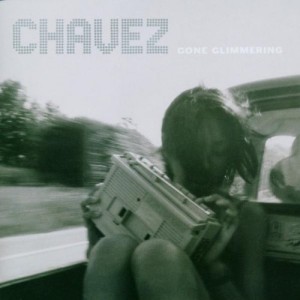
- The Bane: Three things gave the Bane his title. First, he was at the front of the line every week. I can only remember one week when he wasn’t there, and everyone else talked about his absence, especially his two book-dealer friends. I’d try to get there earlier than him, but it rarely worked. Second, he had some preternatural ability to find the records that most interested me and snag them first: Chavez’s Gone Glimmering, Wire’s A Bell Is a Cup…, Fugazi’s Repeater (although I found the inner sleeve, and in a decision born from vindictive angst, held onto it until he left). Third, I found his eBay store after he grabbed that copy of Mission of Burma’s Vs., and I’d check in on what he found and what it went for. This was the record-shopping equivalent of checking in on your ex-girlfriend on Facebook. Nothing good would come of it, but I’d do it anyway. Like a few of the other competitors, the Bane earned my begrudging respect and teeth-grinding hatred. He sped through the racks and only grabbed good stuff.
- The Couple: My second biggest competition was technically two people, since a young, 30-ish dealer brought his girlfriend most weeks. He was primarily interested in jazz LPs and hip-hop twelve-inches, but since he was a dealer, he’d grab anything else of interest / value. It’s likely ageist of me, but I found myself more concerned that younger dealers would recognize the merit of some late '70s or early '80s underground record than their older counterparts. The most frustrating score I witnessed was the girlfriend grabbing an original bound copy of Joy Division’s Still, thinking about it for a second, and putting it in her basket. When I ran into them selling records at the Somerville Rock 'n' Roll Yard Sale in the fall of 2008, I bought a reasonably priced copy of Eric Dolphy’s Out to Lunch, having a strong sense of his profit margin on it. He mentioned that he recognized me from somewhere, and had a laugh when I explained where.
- The Bottomless Pit: No, not Andy Cohen or Tim Midgett. This older dealer pulled absolutely everything out of the racks. If he had the slightly inkling of a record’s value or interest, it went into his heaping basket(s). You could tell if someone was new to the warehouse because they’d see a basket filled with good records, start flipping through them, and then hear the (potential) owner insist “Hello, those are mine.” He was a good spirit about it, which made sense considering his Grateful Dead obsession, but eventually he learned to put a jacket over the basket. Between his thin build, glasses, and hairstyle (balding, white hair but with a ponytail), he could have emerged from any number of local used record shops. Yet the drifter in him dominated; he’d relate stories of how many local Goodwill stores he’d hit up in the previous week. He would have been a stronger competitor if not for the toll that his genial interest had on his speed—he often stopped midway through a rack and pick up a conversation with a fellow dealer about some semi-obscure '60s rock record he just found.
- The Autograph Chaser: The other dealers were interested in records for their value as records, but the Autograph Chaser always looked a step ahead. He was mostly interested in classic rock and novelty records, since he could bring those to casino shows and book signings and presumably rake in the dough. My favorite overheard story was his absolute frustration with Stephen King, who had a reading in Harvard Square but refused to sign any books other than his newest. The Autograph Chaser waited around after the signing to follow King back to his hotel, but the inconsiderate author refused to sign any additional books. That Stephen King, what a dick!
- The Kid: He was one of the last regulars to show up during my time, a college-age kid from Lowell who loved ’70s classic rock. He was chummy with the other regulars, who were more than happy to pass along a worn Queen LP to him. He did have a streak as a dealer-in-training, relating how he bought a few hundred LPs from the backroom of a Lowell store in the hopes of flipping the valuable titles. He also had that Beatles completist streak that comes with every dealer—oh, the conversations they’d have if some remotely hard-to-find Beatles album came up.
- The Stereo Jack's guy: I didn’t recognize him at first, but soon overheard that one of the employees of Stereo Jack’s Records in Cambridge was a weekly visitor to the warehouse. It was strange knowing specifically where the records would show up, but as it turned out with the Bane and the Couple, this situation was not unique. (Sad news update: Stereo Jack’s will close in April.)
These were the most memorable people going to the warehouse every Friday, but I need to stress the gradual increase of attendees. When I started going in the mornings, I could get there at 8:50am and get a good-enough spot in line to snag an open rack. Over the course of the roughly two years I had to roll that back to 8:15am as the line grew from 15 to 50 people. Not all of them were there for the records—there were plenty of retirees stocking up on VHS tapes, book-dealers scouring the shelves for first editions, and even some people cross-checking every book with a bar-code scanner to find valuable titles for resale (I viewed this as cheating, but have since come around to the indispensable value of a smartphone while record shopping). It was like going from the minors to the pros.
The Finds
As I mentioned before, all of this would not have been worth it if not for the occasional gem. As bitterly as I look back upon my defeats, I can flip through my record collection and recall some victories. These may not be the rarest titles I found, but the stories behind them loom the largest.
- The match: I hated seeing someone else grab a wanted record, but the single most infuriating experience at the warehouse was coming across an empty sleeve. For some reason, this happened time and time again with Tom Waits albums. I’d find the sleeve for Swordfishtrombones, pick it up excitedly, and sigh at the missing weight of the vinyl (keep in mind this was before it was reissued). I’d put it in the basket on the off-chance that I’d find the vinyl in a white inner sleeve somewhere else in the racks, but that almost never happened. The exception was for The Smiths’ Strangeways Here We Come, my favorite of their full-lengths. I came across the sleeve (bearing a $4.50 price tag from Mystery Train), then frantically flipped through the racks until I stumbled upon the printed inner sleeve containing the record. I would’ve high-fived someone if I could have.
- The local cache: I’ve already mentioned how finding Mission of Burma’s Signals Calls and Marches EP was the first sign that this place was a keeper, but it wasn’t the last time I’d encounter one of Roger Miller’s projects. One week I grabbed two later Mission of Burma releases (Let There Be Burma and the self-titled EP), two No Man LPs, and a Birdsongs of the Mesozoic LP. Admittedly, most Boston-area used record stores are flooded with No Man vinyl, but at the time I felt thrilled to revisit that well.

- The seed: This entry could have been about any number of artists, since the warehouse filled in major, blinding gaps from the 50s, 60s, 70s, and 80s in my record collection. (A short list: Ornette Coleman, Herbie Hancock, The Replacements, The Rolling Stones, Minor Threat, David Bowie, Meat Puppets, Prince, XTC.) Yet one looms larger as a seed for future purchases. On a week when I found little, if anything else, nabbing the Cocteau Twins’ The Pink Opaque and Tiny Dynamite / Echoes on a Shallow Bay was a gateway drug to the group’s expansive discography. I never found another Cocteau Twins LP at the warehouse, no matter how much I’d hoped to stumble upon Heaven or Las Vegas, but it solidified my curiosity in the group after placing Treasure on my iPod Chicanery playlist.
- The snow haul: My dedication to the warehouse was always a bit stupid, but never more so than a trip up during a snowstorm. I justified it with “I’m driving against the flow of traffic” and left early to compensate, but still felt the clock rushing faster than the stop-and-go traffic. By the time I reached the warehouse, the doors had opened and the vultures had descended upon a particularly heavy load of records. I bolted to the back and sped through the vinyl as fast as I could, hitting pockets of interesting albums like four of Brian Eno’s first five solo releases and the first two Fugazi records. My final haul argued that the ends justified the means, but now I imagine what I would’ve been like if I only encountered Herb Alpert & the Tijuana Brass that day.
- The ’90s day: It took me a while to accept this fact, given my never-ending optimism that the zebra adorning Hum’s You’d Prefer an Astronaut would greet my from the middle of a rack and I’d hug the record and then chest-bump the nearby dealers, but vinyl was a niche product by 1989, let alone 1995. Cassettes and CDs had usurped the market share during the 1980s. This meant two things for post-1989 vinyl: first, there’s significantly less of it around; second, people who bought it were more likely to hold onto it. (The exception? DJs. They’d dump crates-full of black-sleeved hip-hop and dance singles once that movement had passed or their interest had waned.) Finding any rock record from the 1990s was a rarity. I only came away with one qualifying record from what I remember as ’90s day (Helium’s The Dirt of Luck, a favorite I’d owned on CD for years), since the Bane got that Chavez LP and the Couple nabbed Jon Spencer Blues Explosion’s Orange, but seeing all of those Matador titles was a tick of unfounded hope that I might encounter them again.
- The return: The feeding frenzy usually only lasted 15 minutes, by which point I’d seen all of the racks and was contemplating going through them a second time. I couldn’t narrow down my spoils (a process which seems ridiculous in hindsight—these are dollar records—but made sense at the time, since I often only had $10 in my wallet) at this point, though, since my decisions depended on seeing the results of the same process from my competitors. They rarely put anything good back, meaning that a slightly worn copy of some classic rock record might be the only addition to my pile. The exception was when someone—I want to say the Bane—put back an original copy of Dinosaur Jr.’s self-titled debut, back when they were just straight Dinosaur. I suspect that the name change might have thrown the original finder off the scent, but whatever the reason, I was thrilled it happened. (Of course, I would’ve been more ecstatic to grab a copy of You’re Living All Over Me or Bug, but I grabbed those on reissue later.)

- The rarities: I fully recognize that many of my picks are not particularly rare or valuable, but I knew immediately when I found two that were. Sometime during the spring of 2008, when the warehouse was blowing out its inventory, I found original pressings of the first two Big Star albums sitting near the front of a rack. I’ve been tempted to sell them ever since, especially after they were reissued, but I can’t bring myself to do it.
These are the exceptional stories, but most weeks it was a grind: flip through every record, find one of genuine interest and a few titles of relative interest, check out and drive home. Sometimes the records would all be leftovers and I’d come home with a few hardcover copies of Ernest Hemingway novels. Sometimes I’d convince myself to get a classic rock staple so I wouldn’t go home empty-handed. Every now and then there would be a huge week in which I’d bring home 20 records and realize that I’d eventually need to start a meme to get through all of them.
The Demise
I’ve mentioned that all of these records came from charitable donations, but what I’ve glossed over is Got Books’ business model. If you Google “Got Books,” the first auto-fill suggestion is “Got Books scam.” They’re a “for-profit professional fundraiser,” meaning that some of their proceeds go to help non-profit organizations. If you’re expecting all of the proceeds from these sales to go to charity—which you might, since Got Books’ omnipresent donation bins tout “books for charity”—you’ll be frustrated by the percentage that actually does. They do help worthy organizations, but I’ve never doubted for a second that they’re raking in money, especially when you compare what they looked like then with what they look like now.
Got Books’ inevitable expansion crippled the warehouse sale. After a few months of warnings and inventory clear-out (which I’ll close with), they moved from the North Reading location up to a larger building in Lawrence in June, 2008. The new building had a cleaner front-end—which felt like a store, not a warehouse—and more space to sort the truckloads of incoming books, videos, and records. Faced with a longer drive, increasingly spotty stock, and the advent of actual employment, I weaned myself off of my weekly visits.
Got Books also weaned themselves off of the free-for-all warehouse sales. In a series of changes reminiscent of Animal Farm, they recognized the potential for greater profit. Valuable books went up on Half.com. The warehouse store was replaced by a growing number of Used Book Superstores, in which varied (yet still cheap) pricing replaced the old dollar standard: typically $2 for a paperback, $3 for a hardcover. The records were split up between two of these locations (Salem, NH, and Danvers, MA) and given a confounding, color-coded system of pricing: something like $3 the first few days after new stock arrives, $2 the rest of that week, $1 or under after that point. This system penalizes the dealers to some extent, but if something’s actually rare, they’re still going to buy it. For me, rushing out to Danvers on a Thursday morning is neither feasible nor justifiable nowadays.
The Last Hurrah

The fall of Rome sounds like a singular event, but actually took place over hundreds of years. Similarly, although on a much smaller scale, the warehouse’s last hurrah lasted from the winter of 2007-08 into the spring. The available stock gradually increased with more racks, wall shelves, and boxes on the ground. But in some unknown, likely reformatted corner of my laptop hard drive, there’s a grainy cell phone camera picture that perfectly captures its tipping point. They’d opened up the massive curtains which separated the sale area from the sorting area, exposing enormous boxes (5’ by 5’ by 5’) of unsorted vinyl. I’d start by excavating one corner of the box, then hopped over the thick cardboard wall into the box and sorted through its contents. There wasn’t much dignity to the old method, but this arrangement felt like dumpster diving. And somewhere, there’s a photo of middle-aged dealers doing the same thing.
The problem was that the increase in volume didn’t guarantee miraculous finds, OG Big Star vinyl excluded. I remember pulling a few worthy records out of those enormous boxes—XTC’s Skylarking, Raekwon and Run-DMC twelve-inches—and otherwise being astonished by how much crap could be piled up. Prior to those trips, I’m sure I dreamed of swimming through endless dollar bins, finding exactly what I wanted, narrowly beating competitors to major scores, not seeing a single copy of James Taylor’s Flag. After them I likely had nightmares of being buried alive in tombs of Neil Diamond vinyl.
Perspective
There are other competitive forms of record shopping—the masses descending upon the record tents at the Pitchfork festival, local events like the Somerville Rock 'n' Roll Yard Sale—but nothing matches the consistent inconsistency of the Got Books Charity Warehouse. I still have a rush when I find some sought-after title at a record store, but I have to look at the price tag. I have to make a decision based upon that information. At the warehouse, if I saw Ornette Coleman’s Free Jazz, I had essentially purchased Ornette Coleman’s Free Jazz. If I found twenty great records, I could come home with twenty great records without spending $150.
I’ve reiterated again and again the amount of standard dollar-bin fare that I encountered at the warehouse to underscore the sense that this was some mystical source of exclusively awesome records. It took the issues of every record store—varying quality of stock dependent upon recent acquisitions, other shoppers, location, and rate of turnover—and exploded them. Unless you live near Amoeba in San Francisco, it’s unwise to hit any record store too often for anything other than the just-in bin. You’re going to see the same sleeves. That was the beauty of the warehouse—I could go every week, see different shitty sleeves, and maintain a realistic hope that someone who had good taste back in 1982 cleaned out their garage.
|
117. Polvo – In Prism 2LP – Merge, 2009 – $24
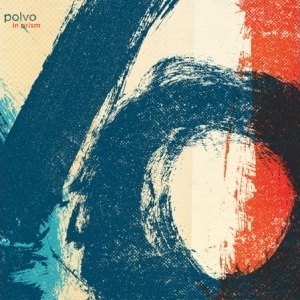
In Prism was by far my most anticipated album of 2009. It was a big enough surprise that Polvo played reunion shows last year, but when they unveiled a few new songs along with greatly revamped classics, I was stunned. I became hopeful that they’d record a new album, which soon enough became reality. By the time that “Beggar’s Bowl” appeared as an advance mp3, I was practically frothing at the mouth. Response to “Beggar’s Bowl” was a bit mixed—the general response was that it was a good song, but it didn’t feel Polvo enough—but I make no qualms about my affection. It’s a stomping, metallic update of their old sound. When I saw Polvo at Brooklyn Bowl in July, I didn't think I could wait much longer for In Prism, yet it would be a few more weeks for the full album to leak and until September 8 for the vinyl. It’s now January, which should be enough time for me to process In Prism.
I won’t make any bones about it: I love In Prism. Is it the best Polvo album? Probably not. Does it sound exactly like vintage Polvo? Not really. Is it far, far better than Shapes? Yes! The last question was the softball I’d lobbed to the album when I first heard it—be better than Shapes, come on, you can do it—but that’s selling In Prism wildly short. They’re simply not going to be the same band they were twelve years ago, which is entirely understandable given their musical experiences since then, the group’s new drummer, and their own ideas about not merely rehashing the past. The biggest difference between In Prism and vintage Polvo is the approach to their guitars. The queasy mid-fi chimes and swoops of Today’s Active Lifestyles and Exploded Drawing had been polished up a bit for Shapes, but the change is far more noticeable now. Guitarist Dave Brylawski even admits to playing in standard tunings on In Prism, which is shocking considering the bonkers alternate tunings they used for those earlier albums. The two big results of this change are 1. a diminished emphasis on those wonky guitar licks as foundations for their songs 2. a higher level of control for song structures and layering. It’s a give and take, but if these developments are the manifestation of the dreaded “maturity,” Polvo has aged marvelously.
The second biggest difference between In Prism and older Polvo albums is the split between Ash Bowie songs and Dave Brylawski songs. By This Eclipse and Shapes, Brylawski’s classic rock influences were readily apparent in his songs, but since Polvo’s original demise, Brylawski’s been keeping busy, most recently as the frontman for Black Taj. That band’s 2008 release Beyonder felt a lot like Brylawski’s later Polvo songs, with an occasional swagger added from being the primary frontman. I expected his songs on In Prism to be close to Black Taj songs, perhaps even repurposed riffs, but that’s not entirely the case. They don’t feel disconnected from the rest of the album, but they do maintain their own separate flavor. “D.C. Trails” ambles along like some of the mellower songs on Fugazi’s The Argument before concluding with some impressive guitar pyrotechnics. “City Birds” has a touch of a classic Polvo riff in its wandering, warbling lead guitar, which flirts with the vocal melody. “Dream Residue/Work” is the most sonically interesting of Brylawski’s songs, starting with an overdub-heavy introduction before hitting a push and pull between driving vocal melodies and moody guitar passages. With more energy, these songs would be highlights of the album, but as is, Brylawski’s laid-back vocal performance relegates these songs to solid album tracks.
Whereas Brylawski’s kept busy with Idyll Swords and Black Taj, Ash Bowie’s songwriting output has been minimal since Polvo’s initial split. His 2000 solo debut, Libraness’s Yesterday and Tomorrow’s Shells, was a cleaning-out-his-closet collection of sketches and demos, which was nice for obsessives but not particularly memorable. He’s spent time as a bassist for the BQs and a touring guitarist for the Fan Modine, but neither of those low-profile gigs even matches his previous stint as Helium’s bassist. This period of compositional silence (he’s supposedly close to finishing two Libraness albums, but I’ll believe that when I hear them) could’ve resulted in a rusty comeback, but Bowie’s five songs on In Prism are all exceptional, like he’d cashed in twelve years of inspiration to prove that he’s still got it. “Right the Relation” is the closest to classic Polvo, starting with a bent-note riff that leads into new drummer Brian Quast’s confident, muscular beat. It’s loaded with stops and starts, left-turn riff changes, nimble bass lines from Steve Popson, and a charged Bowie vocal performance. “I killed my creation / To right the relation” could easily apply to the reunion itself, and after that opening salvo, consider the relation righted.
Three more points about the previously discussed “Beggar’s Bowl”: First, even if Popson and Quast bit the thump-thump-thump bassline and drum breaks from Queen’s “Another One Bites the Dust,” it's a smart theft. Second, the lyrics and vocals update earlier Polvo dream narratives like “Fast Canoe” and “When Will You Die for the Last Time in My Dreams,” which was always my favorite style of Ash Bowie lyrics. Third, the dramatic build-up is still enthralling, and the seamless transition back to the main riff is impressive. Whether “Beggar’s Bowl” sounds like classic Polvo is irrelevant; if this song is the start of the next chapter, I can’t wait to read more.
“The Pedlar” is Bowie’s pop song on In Prism. It somehow turns a jittery guitar noodle into a workable lead, then rewards your patience with an atypically flowing chorus melody and layered synth flourishes in its outro. “The Pedlar” splits the difference between new Polvo and the catchier parts of Magic City-era Helium (dragons not included). I’m surprised it wasn’t released as a single, but it’s not 1994 anymore, so indie rock seven-inches aren’t compulsory.
As great as those three songs are, Bowie’s finest achievements on In Prism are its two longest songs, “Lucia” and “A Link in the Chain.” The former begins with a mournful, reserved introduction, with Bowie’s quivering voice reflecting on “The color of leaves on October trees” before a dramatic crash of guitar. For most bands, this shift from quiet to loud would be enough to carry the song, but at the 2:25 mark, “Lucia” changes course completely, pulling in dueling guitar leads, an enthusiastic Bowie vocal (“New moon / Shadows the sky / Open your eyes and tell them goodbye”) before hinting at the reticent chorus of “Lucia / I thought you were gone.” Midway through, the song splits the difference, building back up with hand percussion, cello, and Bowie’s ghostly titular evocation. Those knotty guitars keep pace, leading the song back to its original charging tempo. It’s a constant tug of war between these elements, but it never feels out of control. Unlike the aforementioned “When Will You Die” from Exploded Drawing, which rambled on far too long for my liking, “Lucia” earns every second of its 8:15 runtime. It’s not quite as long as the album closer, “A Link in the Chain,” which weighs in at 8:47, a ponderous exploration of Polvo’s new motifs. There’s Brylawski’s mid-tempo fetish, which Bowie anoits with restrained emotion on “Now with a gentle word / You send a chariot to send me home,” the woozy sonic burst of “Dream Residue/Work,” the emotional range of “Lucia,” and the layered guitars of “Beggar’s Bowl.” It’s essentially 1970s progressive rock in range and structure, but unlike the classic rock appropriations on Shapes, it always feels natural. The tides of guitar that conclude the song are as majestic as anything Polvo’s done before.
Comparing Polvo’s reformation to those of Mission of Burma and Dinosaur Jr. is surprisingly favorable for Polvo. Mission of Burma’s comeback has been remarkably rewarding (see below), equaling the energy and passion of their earlier work if not quite the same level of inspiration, although The Obliterati by no means lacks inspiration. Dinosaur Jr.’s comeback has been universally acclaimed and I certainly enjoyed Beyond, but I felt diminishing returns on Farm for the very reason people have praised it. Dinosaur Jr. is too comfortable playing what they think a classic Dinosaur Jr. song should sound like, even if the band dynamics nowadays are 180 degrees different from that classic era. Isn’t there an inherent laziness in choosing not to progress and instead giving listeners exactly what they expect? Polvo’s reunion shows demonstrated a welcome unwillingness to cede to those expectations, choosing to tear older songs apart and build them up anew, and In Prism features a similar view of the past. There are ties to their past sound—“Right the Relation,” especially—but most of the record takes new directions, new approaches, some of which you may very well not like as much as Exploded Drawing. If the crowning achievement of the new Dinosaur Jr. albums is that they sound like their vintage SST albums, doesn’t that imply that you still prefer You’re Living All Over Me and Bug? I do. Even with Mission of Burma, my fondness for The Obliterati never threatens to surpass my appreciation of Signals, Calls, and Marches or Vs. Even though I answered it in negative, my earlier question about whether In Prism is the best Polvo record still matters, since I had to debate it. In Prism might not equal Today’s Active Lifestyles or Cor Crane Secret, but five months in, I prefer it to Exploded Drawing, which is still quite an achievement. Who knows how these albums will rank in another twelve years.
118. Mission of Burma – “Innermost” b/w “… And Here It Comes” 7” – Matador, 2009 – $6

I had to double-check Matador’s web site to be sure that this double A-side single wasn’t an advanced shot from Burma’s upcoming The Speed The Sound The Light LP, since Burma did that series of one-sided twelve-inch records in advance of The Obliterati without including any new material. Sure enough, “Innermost” and “…And Here It Comes” will not appear on the album.
I do take issue with calling it a double A-side, however, since “…And Here It Comes” has all of the direction, melody, and momentum on this single. The chorus is as good as anything on The Obliterati, which seriously whets my appetite for the new album. “Innermost” feels downright wonky in comparison, pushed forward by a big bass sound and an off-tempo. Maybe it’ll grow on me, but for now I’ll keep the single on “…And Here It Comes.”
119. J Dilla – Donuts 2LP – Stones Throw, 2006 – $15
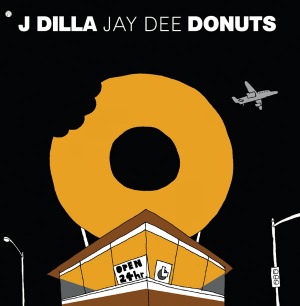
I went to Newbury Comics hoping that another big recent release—Raekwon’s Only Built 4 Cuban Linx… Pt II—would be pressed on vinyl and available for purchase, but that didn’t happen (and to my knowledge, still hasn’t). It did get me flipping through the hip-hop vinyl, in which I found J Dilla’s Donuts. I’d recently skimmed it and felt interested enough to merit the purchase, so I went with an increasingly rare impulse buy of a new LP.
If I paid more attention to hip-hop, I would’ve known about J Dilla (Jay Dee) years ago, since he was quite busy in the mid 1990s producing tracks for artists like the Pharcyde and A Tribe Called Quest. Instead, I only heard about his solo albums after the fact. J Dilla died of the blood disease TTP in 2006 at the age of 32, just three days after the release of Donuts. It’s the sort of life story that could cloud my judgment of an artist’s work, but Donuts would be surprisingly affecting even without its tragic context.
Donuts’ closest aesthetic match in my collection is DJ Shadow’s Endtroducing, another instrumental hip-hop album, but J Dilla takes an entirely different approach to sonics and song structures. Vocals and samples are chopped up and looped, creating a swirl of syllables that eliminates any need for an MC. Soul samples dominate the underbelly, but almost every song has some ingenious touch that turns my ear. The most arresting aspect of Donuts is its architecture. At 45 minutes and 31 songs, song ideas never overstay their welcome and frequently leave me wanting more. Yet it’s how these pieces fit together that truly impresses. It reminds me of Guided by Voices’ Bee Thousand and Alien Lanes in how most tracks make far more sense within the context of the whole, how tracks reflect upon each other, how a switch in tone or tempo makes one song sound that much better. One comment on Stylus’s review of Donuts mentioned how the reviewer failed to mention a single song title, but that makes complete sense to me. Directing a listener to sample one song in the middle of the album defeats the purpose.
31 short songs without structural doubling or tripling is a veritable pupu platter of production treatments, so it’s no surprise that most tracks from Donuts have been utilized by MCs on their albums and mix tapes. Yet right now, I’m not itching to hear the rapped-over versions. No slight to any MC choosing one of these beats—good taste, at least—but being able to hear these songs once and figure out more of the overall puzzle is a more enticing proposition.
|
|
I made it to the actual Jive Time Records in Fremont on Sunday, but aside from some overpriced items in the just-in section, there wasn’t much that piqued my interest. I recall a similar experience visiting this store the last time I was in Seattle; that time I went to the Sonic Boom vinyl annex down the street, this time I went across the street to the Vintage Mall with an impressive stockpile of cheaper vinyl. I probably would have picked up a few more albums (the Reach the Rock soundtrack, for one) if I wasn’t concerned about the impending problem of bringing all of my recent scores back to Boston. Definitely go to the Jive Time Annexes before the main store, especially if you’re not consumed with finding a mint copy of a given album.
41. No Knife – Fire in the City of Automatons LP – Dim Mak Japan, 1999 – $5
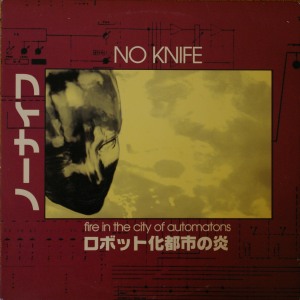
I first heard this album when searching for “Academy Fight Song” on SoulSeek; I downloaded a No Knife track by that name expecting a Mission of Burma cover and got a mislabeled homage (“Academy Flight Song”) from Fire in the City of Automatons. The combination of stop-start rhythms, racing guitar lines, and melodic vocals make a strong argument with me, so I grabbed the recent of the album and enjoyed it a great deal. No Knife is too smooth and too melodic to fit in with the post-hardcore crowd, but has too much depth to be written off as alternative rock, which I imagine caused some difficulties when they were trying to fit in with their native San Diego scene. I have their debut album, Drunk on the Moon, which isn’t as catchy or tight as this one, and I’ve heard their last album, 2002’s Riot for Romance!, which has some excellent moments (the title track, the lilting “Feathers and Furs”) that match anything found here, but Fire in the City of Automatons has always been my favorite of their albums, so finding the Japanese LP pressing was quite a coup. No Knife recently played their first shows since 2003 in support of Jimmy Eat World’s Clarity anniversary tour, so a new album or a longer tour may be forthcoming.
|
1. Birdsongs of the Mesozoic - Magnetic Flip - Ace of Hearts, 1984
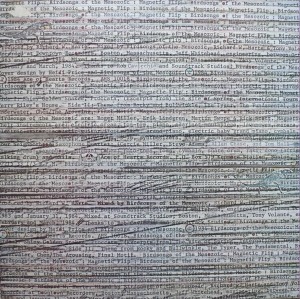
Why I Bought It: I grabbed this LP along with a handful of other post-Mission of Burma releases by Roger Miller, knowing little about it beyond Miller’s participation.
Verdict: Magnetic Flip attempts to merge Burma’s artier elements with modern classical compositions, bridging the gap between Miller’s stay in music school and his punk rock band. Using a forceful array of piano chords, organ leads, guitar textures, and drums, Birdsongs of the Mesozoic appropriate the Terry Riley/Steve Reich school of modern composition for a rock context, even naming one of the LP’s finest tracks “Terry Riley’s House.” A few of the songs touch upon Brian Eno’s instrumental work (according to Wikipedia, the band covered Eno’s “Sombre Reptiles”), giving an often claustrophobic mix room to breathe. The end result is intriguing, but often sonically overwhelming. I could have done without the reimagining of Stravinsky’s “(Excerpts from) The Rite of Spring,” which loads on too much dramatic tension for the already-laden aesthetic blueprint to stand, and the cover of the “Theme from Rocky and Bullwinkle” is curious at best. While I can appreciate the importance of forming an instrumental group in the early 1980s to push the boundaries of what independent/underground music could entail, I’d ultimately rather listen to Mission of Burma or Terry Riley than a combination of the two.
2. New Order - Confusion - Factory, 1983
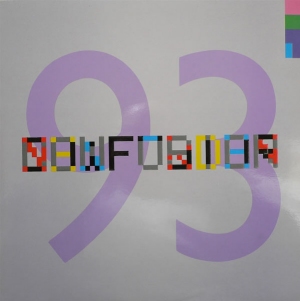
Why I Bought It: In addition to my subconscious desire to hear four version of the same New Order track, I enjoy the graphic design of Factory sleeves and Confusion is no exception.
Verdict: “Confusion” isn’t my favorite New Order song, but having an instrumental version of it allows me to avoid one of Bernard Sumner’s most vacuous lyrics, “Ask me no questions, I’ll tell you no lies.” Additionally, the emphasis on electronic dance music in “Confusion” (DJ/hip-hop producer Arthur Baker had a hand in its composition) justifies the inclusion of a beats-only version and an instrumental version, which, amazingly enough, are noticeably different. The sleeve isn’t nearly as cool as the “Blue Monday” floppy-disk homage, but matching that iconic sleeve is a tall order.
3. The Feelies - The Good Earth - Coyote, 1986
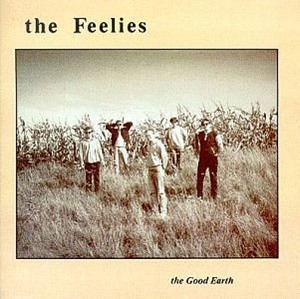
Why I Bought It: While I’ve never reached the point of obsession with the Feelies’ heralded debut Crazy Rhythms, I enjoy the record enough to try out its follow-up.
Verdict: The Good Earth starts off with a handful of relatively non-descript, jangle-heavy college-rock songs. While these songs are sonically inoffensive, they sound less like a band influencing their peers (namely R.E.M.) and more like a band being influenced by their peers, perhaps one playing catch-up after six years had passed since the release of Crazy Rhythms. Glenn Mercer’s vocals tend to settle into the music rather than peak nervously above it, the guitars rely too much on standard chord progressions, and the rhythms—even with two drummers—don’t match up with its predecessor’s namesake. Starting with the fourth track, “Slipping (Into Something),” the record shows signs of life. “Slipping (Into Something)” spreads out over six minutes, emphasizing its dueling melodic leads over the occasional jangle before accelerating into a fever pitch. “When Company Comes” returns to jangle mode, but the absence of percussion is a relaxing end to side A. Side B is consistently good, with highlights like the rhythmic pulse of “Two Rooms,” the electric leads of “Tomorrow Today,” and the quiet burn of the aptly titled “Slow Down.” Isolating these interesting elements of the Feelies’ sound helps me appreciate Crazy Rhythms more, since those elements comprise the vast majority of that album rather than the highlights of certain tracks. Still, for what seemed to be standard 1986 college rock midway through side A, The Good Earth has a great deal to offer beyond a new gateway to its superior predecessor.
4. Beck - One Foot in the Grave - K, 1994
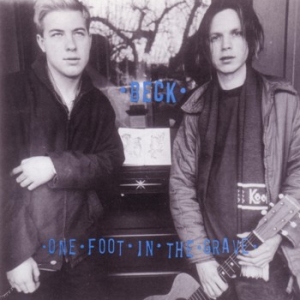
Why I Bought It: It’s significantly harder to find cheap, used vinyl pressed after 1990, so whenever I see anything resembling indie rock I’ll snap it up, particularly, like in this case, if I think it could be worth something on eBay. (While this record sells for up to $30, unfortunately there’s enough of a scratch on side A to prevent me from selling it.) I’ve never been a Beck devotee, but considering that my primary reason for this stance—my perception that Beck values style over substance in his genre-hopping exercises—doesn’t apply to a primarily acoustic endeavor, One Foot in the Grave might help me turn the corner on his work.
Verdict: Most of One Foot in the Grave sticks to a traditional folk/blues blueprint, relying heavily on Beck’s vocals, acoustic guitar, rudimentary drums, and the occasional counterpoint of K Records/Beat Happening honcho Calvin Johnson, who also produced the album. The few tracks closer to the lo-fi hodge-podge of Beck’s other early records linger on side A, which I listened to after the more stripped-down side B. There wasn’t a watershed moment of Beck appreciation, although I enjoyed “Girl Dreams,” “Hollow Log,” and “Asshole” (the lyrics of which were scribbled on the inner sleeve by the previous owner). I’ve admittedly had more fun skimming the Amazon reviews of the record, which sway from five-star odes to Beck’s “naked” album to poorly written one-star scoffs at its fidelity authored by “a kid” to this gem of a confused response, which is funny regardless of its possibly satirical intent. Where do I fit in to this glorious array of criticism? If One Foot in the Grave had been recorded in, say, 1997, after the success of Mellow Gold and Odelay, I would question its authenticity, tossing it aside as a cred-building exercise. But the timeline of its release is generous to Beck. Instead of figuring as a response to his musical surroundings or perceived audience demands, One Foot in the Grave comes off as a document of pre-stardom necessity. While the record is bolstered by Calvin Johnson, Presidents of the United States of America guitarist Chris Ballew, and Built to Spill drummer Scott Plouf, its appeal boils down to the limitations imposed by coffee houses and open mic nights. And honestly, I don’t frequent such establishments searching for the next Dylan, so I’ll take a handful of the better tracks and move along.
5. Glenn Gould - Bach: The Goldberg Variations - Columbia Masterworks, 1956
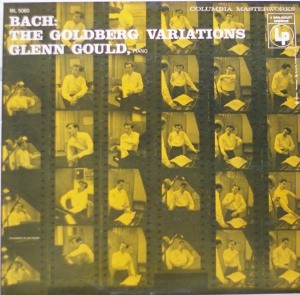
Why I Bought It: Two separate anecdotes: The first time I heard Glenn Gould’s name was when I read Giorgio Agamben’s The Coming Community in an Agamben/Kristeva seminar during graduate school. Agamben mentions Gould in a section about potentiality, essentially stating that Gould’s retreat from live performance into the studio emphasized the capacity to perform and not perform at the same time. (I could relate this concept more fully, but I’d rather avoid scouring my hard drive for a short paper on the topic.) Shortly after this instance, my mom read Gabriel Josipovici’s novel The Goldberg Variations and asked me if I could track down a copy of its musical namesake. After downloading a harpsichord rendition of the piece (the instrument the piece was written for, but I shudder at the thought of hearing a harpsichord), I grabbed Glenn Gould’s piano performance. A few months later I found the LP.
Verdict: Given that I hadn’t heard Glenn Gould’s name until a year ago, I won’t embarrass myself by critiquing his performance or J. S. Bach’s composition, although according to Wikipedia Gould himself “later came to criticize his early off-beat and lyrical interpretation, expressing reservations about its pianistic affectation, overt emotionalism, and lack of temporal unity.” I mean, I hadn’t even thought to do any of that. For my purposes, The Goldberg Variations is too busy to accompany reading, since the thirty separate variations switch up the pace frequently enough to gain my attention. Damn you, Bach and Gould, for daring to pull my attention from The Trouser Press Guide to ’90s Rock. It’s hard not to be impressed by both composer and performer, however, so I’ll continue to pick up Gould performances on the cheap—I have at least one more in the queue—but finding the right time to listen to them may be the biggest challenge.
|
|
