|
I hadn't heard of Prints, but seeing Temporary Residence in the leak title made me curious. Sure enough, it's another Howard Hello / Pinback / Tarentel offshoot from Kenseth Thibideau, focusing on the layered pop that made Howard Hello's "More of the Same" such a great song. While "Easy Magic" takes the cue of that song's wordless vocals, it also incorporates real lyrics, or close approximations thereof. There's a verse, but most of the song revolves around the lines "Is it magic? If it's easy / If it's easy," which seem ridiculous taken out of context. Trust me. It works.
Temporary Residence doesn't hold back any names in the press release—"Merging the eclectic instrumentation of Talking Heads with the ethereal vocals of Peter Gabriel, the two mingle the precision of Brian Eno and the jubilance of Brian Wilson"—but I'd make a closer comparison to the poppier moments on Jim O'Rourke's Eureka.
|
|
In lieu of my monstrous “I’m back from Europe and lord am I behind on my iPod Chicanery” update, here are my thoughts on some recent music.
Feedle - Leave Now for Adventure: A former member of 65daysofstatic provides this solid album as evidence of what his former mates’ newest album is missing: nostalgia mixed in between fuzzed-out electronic loops and thumping beats. It’s not quite the long-awaited sequel to Accelera Deck’s Narcotic Beats, but it’s certainly held up well to a near continuous stay on my laptop for the last week and a half. Start with “Go Home Revolving,” “Man vs. the Hallucinations,” “Song for Dogs,” and “The Way Things Turned Out” and it’s not long before the rest of the album falls in line.
Minus the Bear - Planet of Ice: Sounding like early ’80s Yes and Genesis now counts as creative development, since the vaguely progressive half of Planet of Ice is more intriguing than the echoes of Menos el Oso’s serious party music. I’ll take “Knights,” “Dr. L’ling,” “When We Escape,” and “Lotus” and imagine some sleight of hand that would bridge the enormous gap between Jake Snider’s lyrical inspiration (“Here’s my progressive rock concept album!”) and execution (“So there’s this chick…”).
Lights Out Asia - Tanks and Recognizers: This album is quite a departure from the balance of power between electronica and post-rock displayed on their debut Garmonia. The mix is fuller and more instrumentally varied, but at times—the lunging “Four Square” in particular—Lights Out Asia sound more like Aurore Rien and less like Garmonia’s compelling mix of electronica and Talk Talk–esque vocals. Not feeling it yet.
Lindsay Anderson - If: One half of my beloved L’altra finally has a solo album to supplement the live set from 2005 that I downloaded from eMusic. I’m only one listen in, but it hasn’t quite grabbed me in the same way as Different Days, and not for lack of trying. Most of these songs are fleshed-out, full-band editions with the unfortunate tendency of overwhelming the headliner’s voice. Here’s hoping that If is a grower.
Smashing Pumpkins - Zeitgeist: I made it through almost half of this album, which I felt was some kind of accomplishment given the ear-splitting vocal mix. The sledgehammer combination of the ultra-compressed riffs and Jimmy Chamberlain’s drumming occasionally hits the spot, but more often it just makes me long for spacious mix of Siamese Dream. Oh, “Soma.” At the very least, I can finally agree with my best friend from eighth grade, who insisted that Billy Corgan’s voice cripples the band.
Interpol - Our Love to Admire: The amazing thing about the initial hype about Interpol was that it wasn’t just centered on Turn on the Bright Lights, but salivated equally over their potential as a band. I don’t think there’s much talk of that nowadays. “Pioneer to the Falls” begins the album with a delayed guitar lead that sounds like it’s been Xeroxed twice already, and aside from more Paul Banks lyrical buffoonery, the record holds few surprises and little of my interest.
|
|
I had a conversation with Jon Mount a few nights ago about how I’m far more inclined than he is to return to mid ’90s records (or fill in the gaps from records we respectively missed). Well, there are some exceptions. One of our big talking points was the first album on this list, which got me thinking about other indie or alternative albums that I’ll likely never listen from start to finish again. Sure, I may hear a song or two, but this list is about dedicated listens. Most of these albums are from bands I even enjoy or enjoyed in the past. This list could be much, much longer, but these were the albums that stood out upon first glance at my record collection Excel database.
Smashing Pumpkins - Mellon Collie and the Infinite Sadness: Every now and then my mom brings up how I got my dad to drive me to Circuit City/Media Play/etc. to pick up this album on the night of its release. I don’t have the heart to tell her that I sold the album off at some point—likely between my senior year of high school and my freshman year of college—or that this record taught me a considerable amount about how artists turn away from their strengths. Jon mentioned how he sold it off within a few days, but it was a far more gradual process of acceptance for me. I think I like some of these songs. Right? That process was helped by Billy Corgan’s radical change in appearance, in which his shaved head and increased heft encouraged me to compare him to a bloated tick in the videos and live appearances. Mirroring your supposed magnum opus’s greatest weakness in your physical appearance is an awfully noticeable tell, Billy.
In terms of the actual album, I could probably make a reasonable single disc from the era, containing the album tracks I wouldn’t mind hearing again (“Bodies,” “Stumbeleine,” “Jellybelly,” “Muzzle”) and maybe a few of the b-sides (“Set the Ray to Jerry”) from the array of singles that accompanied the album. (I officially stopped buying them after 1979 and was rather ticked about that box set.) I could complete this task so long as I never again have to hear one of Corgan’s overblown attempts to grasp at teenage angst or one of James Iha’s horribly bland vocal tracks. Part of me wonders if the switch of the dominant genre tags from “alternative” to “indie” that accompanied my casting aside of my favorite band circa age fourteen might have caused me to be a bit too rough on the Smashing Pumpkins’ later works, but remembering how bland the Zwan record was, even with Pajo and Sweeney in tow, prevents me from worrying too much.
Hum - Fillet Show: If anything, Hum replaced Smashing Pumpkins as my favorite band (admittedly remaining within “alternative”), but my later burn-out on their material had far more to do with the logistics of my fandom, like running a fan site and answering daily questions about their vague demise. Lately I’ve returned to their three main albums and found that my old stances have held up: Electra 2000 is a bit too rough in parts, but has some of their finest moments; You’d Prefer an Astronaut is thematically and musically their best album; and the over-thought gloss of Downward Is Heavenward betrays some of their better instincts (the original edge of “Comin’ Home,” the delay-heavy live intro for “Afternoon with the Axolotls,” the space of the demo version of “Ms. Lazarus”), even if the album stands up fairly well. Their debut, however, is not a record I intend to check up on. I own Fillet Show on cassette, since the CD was out of print by 1996, but I don’t think I made it through the album as a whole more than once. It’s essentially a different band: one that lacks Tim Lash’s focused leads and Matt Talbott’s introspective lyrics. And hey, those are the main things I like about Hum.
New Wet Kojak - New Wet Kojak: Competing with Hum for my favorite band status circa 1997 was Girls Against Boys, which meant that I indulged Scott McCloud and Johnny Temple’s late night jazz-ish project for a few albums. Their self-titled debut established the aesthetic (whispered Beat gibberish, dirty grooves, horns) but I don’t recall more than two actual songs on the album and I don’t want to confirm that assumption. I’m writing this at 1:30pm, which means that any New Wet Kojak material will sound downright hilarious when accompanied with the clarity of daylight. I’ll indulge the better moments of Nasty International or Do Things if I’m driving around late at night, but the self-titled will continue to collect dust on my shelf.
Jawbox - Grippe: I returned to Jawbox’s second album, Novelty, in this round of iPod Chicanery, but that does not mean I’ll be digging their debut out of my CD cabinet anytime soon. Fillet Show is an interesting point of comparison, since debut albums show the respective bands in their infancy, but whereas Fillet Show shows a different band with two different members playing essentially disparate material from the follow-up, Grippe only lacks Bill Barbot’s second guitar position, which filled out Jawbox’s sound. It’s a dry run for the considerably better Novelty, which I even assert pales in comparison to the Zach Barocas–enabled complexity of For Your Own Special Sweetheart. I won’t rule out listening to a track down the road (the Joy Division cover, “Bullet Park”), but the whole thing? No thanks.
Wolfie - Where’s Wolfie: It’s rather unfortunate that Signal Drench’s legacy is essentially a footnote in a Brent DiCrescenzo review of this album on Pitchfork, which calls out one of my contributors’ (Ty Haas) review of the record and then implies that writing Wolfie-esque music would impress “the guy who runs Signal Drench,” or, you know, me. In comparison to the bands I’d actually stake that magazine’s legacy (and the four years of my life that it involved) upon—Durian, Shiner, Rectangle, Bald Rapunzel, Tungsten74, etc.—Wolfie is an outlier. Their youthful, technically deficient indie pop does not hold up well. Whereas Awful Mess Mystery had a few passable songs for the Rentals-obsessed Kick Bright crowd (“Subroutine the Reward,” “Mockhouse”), Where’s Wolfie played up almost all of the band’s embarrassing traits—the nasal vocals, the cutesy lyrics, the fuzzy production as a vague attempt to move forward. The band themselves moved away from this approach with their later records (and the post-Wolfie band The Like Young). I can’t imagine listening to a single song from this record again, except for penance. Oh: I even own a Wolfie side project, Busytoby’s It’s Good to Be Alive, that I picked up for no more than a dollar. That record doesn’t apply to this list since I never listened to it in the first place, but maybe its memory will merit a different list.
Weezer - The Green Album: I bought this disc the week it came out, despite having heard the lead single (“Hash Pipe”) and presumably knowing better, since I had seen the band phone in a performance back in March of that year. Like the Smashing Pumpkins, it took a bit more time to recognize that Weezer had completely lost my interest, but The Green Album certainly confirmed that feeling. This album is one of the laziest displays of songwriting I can fathom. I’d sell it off, but I’m fairly sure that a million smarter people beat me to it.
Centaur - In Streams: Centaur may be the single biggest disappointment in my years of listening to music. Given the combination of the singer from Hum, the bassist from Castor, and a Champaign-Urbana scene drummer who works at Parasol, I figured that getting in on the ground floor of Centaur’s existence by attending their first ever show at a VFW in Danville, Illinois would be a rewarding experience. Most of what I remember from that show is how loose, how seemingly lazy the band’s performance was. They numbered their songs, but debated about which songs those numbers applied to. Every song boiled down to this blueprint: take a heavy riff, repeat it, sing a verse, apply wah and distortion to the riff for a solo, play another verse, sing what may be a chorus, do another solo. It was heavy and sad like early Codeine, but all too repetitive. The skeletal structures of the songs meant that those riffs became tiresome by the end of each song. Little did I know that those songs were much closer to finished than I could have imagined.
The disappointment comes from what Centaur could have been. In Streams is a profoundly sad album about some of Talbott’s personal tragedies, but making through it from start to finish is a nearly impossible task. “Wait for the Sun” is a bit lighter and fleshed out, but it’s still too long. “The Same Place” takes a solid riff and embraces its title far too much. Talbott’s meditations on life and death are intriguing, but there’s so little energy propelling them. I don’t know if adding Tim Lash’s leads would corrupt the album’s topical focus, but it’s so remarkably telling that Lash’s album as Glifted is interesting aesthetically without containing any actual songs, while Centaur’s lone effort has interesting lyrics languishing in a lack of aesthetic. I saw at least six Centaur shows without seeing much improvement from the first. I may pull out a song from time to time, but In Streams as a whole is marked with a profound sadness beyond its thematic ruminations.
Pavement - Terror Twilight: If there’s an album that I might reconsider, it’s this one. I certainly tried to like Terror Twilight, but it just encapsulates too many of late Pavement’s bad tendencies for me to sit through it as a whole ever again. The overdone production values are somewhat understandable, but the forced attempts at spontaneity are downright insulting, the “quirky” tracks like “Carrot Rope” make me shudder, and it’s a precursor to Malkmus’s underwhelming solo career. I’ll willingly listen to the following songs: “Spit on a Stranger,” “Cream of Gold,” “Major Leagues,” “Speak See Remember,” and “The Hexx,” even though the two singles are unsuitably melodramatic and “And Then…” overshadows the “The Hexx.” The middle stretch of the record is something I’d prefer to block from my memory. If I have to choose between the mixed bag swan songs of big 1990s indie rock bands, Archers of Loaf’s White Trash Heroes and Polvo’s Shapes come long before Terror Twilight.
Rex - Rex: Though Rex’s debut contains their finest song (the impossibly melancholic “Nothing Is Most Honorable Than You”), I could never make it past the album’s mid point without a concerted effort. I could probably include Rex’s overlong follow-up, C, on this list as well, and throw in their finale, 3, given its somewhat bland character in comparison to the high points of its predecessors. Rex is by no means a singles band, but they certainly aren’t a band I enjoy enough to stomach an entire album from in one sitting.
|
|
Ghost Wars posted a new song on their MySpace page tonight. I've upped the song, "Virginia ,Long Exhale," as well. Put on some headphones so those clarinets don't get lost in the hum of the window fan.
There's also an update about the recording on the page (the short: the computer holding the ProTools sessions was stolen, the back-up hard drive is nearly unsalvageable, now the debate is between re-recording or slowly recovering past sessions), which may reconvene in August or September. Again, if Ghost Wars release an album in the next seven months, all of the other records are jockeying for second on my year-end list.
|
|
The NHL season is over with a bit of a collective sigh, since for the third straight season an American team from a traditionally non-hockey market has hoisted the Cup over a Canadian opponent. Given that I cheered for the Lightning and the Hurricanes over the Flames and Oilers respectively, I hardly maintain the hard line stance of wanting the Stanley Cup to go “where it belongs,” but this year some of my more strident reasons for choosing teams swung away from the American city, even if they didn’t necessarily swing toward the Canadian city. First, like Calgary and Edmonton before them, Anaheim defeated my Detroit Red Wings on the strength of spectacular goaltending and timely scoring. I’ve rarely been able to cheer for the team that downs the Wings, but this year in particular was rough. I genuinely believe that if the Wings had Schneider and Kronwall manning the blue line, they would have won the series. The Ducks had only one injury to speak of—Chris Kunitz’s bum hand—and received an astonishing amount of lucky bounces during the series (game four had two key trickle-in goals for the Ducks). Sour grapes? Sure, but the Ducks were dominated in several of their wins.
Second, if I don’t have any particular affinity for the teams involved, I usually go to which players I like the most. In 2004, the Lightning were led by Martin St.-Louis, one of my favorite players since back in his days at Vermont. In 2006, I enjoyed Erik Cole’s comeback from his frightening back injury. It also didn’t hurt that each of the opposing teams had one of my least favorite players: the Flames had spear-happy pest Ville Nieminen and the Oilers had mammoth cheater/crybaby Chris Pronger. Lo and behold, Pronger leaves Edmonton under a cloud of suspicion during the off-season to end up with the Ducks. While I don’t have much against many of the other Ducks players (except for goaltender-magnet Corey Perry, who got away with interference infractions that would have sent Tomas Holmstrom to a secret prison for a decade), the thought of Pronger pumping the Stanley Cup over his head was enough to make me vaguely side with the Ottawa Senators. My Canadian friends either followed Ottawa or banded together in national pride, which is usually something I’d enjoy cheering against, but pugilistic netminder Ray Emery is a more palatable evil than Pronger. Yet I could never find myself cheering for the Sens, only hoping they’d prevent a Ducks victory.
My overall malaise about the finals—hoping for a tight, entertaining series rather than cheering for one particular team—was certainly mirrored in how I watched the games. I caught parts of the first two games and game four on muted bar televisions, missing some key moments as they happened live but getting the overall tenor of the games. I saw all of game three and all but the final few minutes of game five, though. It shocked me how lifeless Ottawa could be in the first period of game five. Heatley and Spezza were completely absent and Emery proved that he’s not on the same level as most of the other playoff goalies, but the team as a whole seemed unfocused. If they had won the Cup with this level of effort, it would have been a damn shame.
I hand it to the Ducks—there’s no debate about who deserved to win the series—but it’s a bummer that the series is over with such consensus. Whereas the Flames could have easily won if the goal judge had been a bit more lenient and the Oilers could have won if Roloson hadn’t been hurt, the Senators were simply outclassed. I have to hope that next year provides my Sabres–Wings final.
|
|
Here’s a heads-up for Silkworm/Bottomless Pit fans: Bottomless Pit has three new songs streaming from their MySpace page. All three are Tim Midgett vocals, which is a bit surprising given the even split of the four tracks from the band’s CD-R (and the usual Midgett/Andy Cohen equilibrium on Silkworm records), but hardly a detriment given the songs’ uniform excellence. “Leave the Light On” is my immediate favorite, a dynamic, emotional rave highlighted by a closing flurry of guitar, but “Repossesion” and “Winterwind” both bring back some of Midgett’s usual vigor. Think his peppier numbers from Libertine with more of an ’80s New Order approach. The forthcoming album, Hammer of the Gods, will feature eight songs and will soon be available for preorder on double LP (with two songs per side at 45 rpm), so keep an eye out for it. Given that I’ve heard seven of the eight tracks, there isn’t much mystery left to unveil, but these new songs solidify the album’s place in my year-end thinking.
In unrelated news, I hope to finally implement some long-awaited changes to this site in the next few weeks. This will involve a server change, so if the site is down for a day or two, there’s your explanation. After the server change, I should have “clean” urls for all articles, meaning that awkward page names like index.php?id=68 will be a thing of the past. Additionally, I hope to make the archives considerably easier to navigate by differentiating some of my lazy category headings (like the nearly 30 posts I have under “music”), adding a specific archive pages, and maybe, just maybe, giving my photography actual pages. Other hopes/dreams that will more likely not come to fruition: a new (or at least modified) site design, more ongoing memes like iPod Chicanery, an update of my best of the 2000s, and a personal top 100 of the 1990s.
|
|
Even though it’s an albatross for people trying to push away from the Pitchfork crowd, I’ll readily admit my fondness for the Arcade Fire’s Funeral. I saw the band back in November of 2004 and was completely pulled in by their enthusiastic performance at a small club in Champaign. I fully expected a rise in popularity, but I’m not sure if I anticipated things like the David Bowie and David Byrne collaborations. Given this overwhelming hype for the band and the record, I decided to wait until I could pick up Neon Bible on vinyl before giving it a listen. (Well, I heard “No Cars Go,” but that one’s a re-recording.) I figured two things—one, it would be a throwback to my high school days of purchasing the album on the day of release and quickly heading home to hear it in its entirety; and two, I wouldn’t get too involved in the initial rush to judgment. I did not know that the vinyl release would come two months after the CD release, but I decided to wait anyway.
I picked up the album last week and finally found the spare hour to hear it tonight. I wrote down my notes in haikus, inspired by Floodwatchmusic’s reviews of each song, so I’ll start with those:
“Black Mirror”
Awkward stage banter:
“This one’s about my mirror.
Pretty dark, huh guys?”
“Keep the Car Running”
Let’s add some hand claps.
That last one was a downer.
Now we’re smiling, scared.
“Neon Bible”
A concept record
About not having much fun
Certainly not here.
“Intervention”
Hear this soldier groan.
Order them some subtlety,
Destroy that organ.
“Black Moon / Bad Vibrations”
New side, more Regine.
Did she get concept memo?
Some fun to be had.
“Ocean of Noise”
After muted start
Strings arrive, aching wildly.
Phew, just in time, Win.
“The Well and the Lighthouse”
An uptempo romp
Gazing upon “water black.”
Overbearing hope.
“Antichrist Television Blues”
The E Street Band called,
Said you could use some hot sax,
Less background yelping.
“Windowsill”
It’s not wartime angst.
More like “Screw you, Dad! I’m gone!”
Oh, see last album.
“No Cars Go”
Retread or new life?
Well, there is more energy.
But that “Woo!” was lame.
“My Body Is a Cage”
Starts off R&B
Then adds vampiric organ.
Train-wreck in slow-mo.
Those haikus may very well state similar sentiments to Floodwatch (I tried not to go over his before listening to the album), but I’m going to up the ante and write a sonnet about the album as a whole.
Neon Bible
Watching months lurch their way past my platter,
The anticipation caked up like dust.
Their exuberant whirl did not scatter,
It rather formed an exalted white bust.
With such iconic personage at stake,
How can one maintain realistic hope?
Bands must change, must evolve; the seams must break.
No choice but to explode, expand the scope.
Was this vigilant edict brought too far?
Now nothing seems out of bounds, no lines drawn.
The personal—once critical, now barred.
New task: to find the grass within the lawn.
From out of darkness into diaries,
To return voices from nations to pleas.
The bar has been raised, FWM. I expect Spenserian stanzas about each song of Stars of the Lid’s And Their Refinement of the Decline within the week.
|
|
The Red Wings season is now over, having fallen to the Anaheim Ducks in six games. Yes, they were the top seed in the west, but most experts picked the Wings to lose to the Flames, then the Sharks, and then the Ducks, so perhaps the conference finals exit is more of an achievement than most prognosticators will admit. The Ducks certainly had the best goaltender remaining in the playoffs in pending free agent (more on that in a bit) Jean-Sebastien Giguere and a fearsome tandem on defense, but their lack of offensive depth gave the Wings a definite opening, one that they couldn’t quite grasp. When the Wings stuck to their 2007 game plan by causing havoc in front of the net, cycling the puck, and rotating their positions in the offensive zone, they put the puck in the back of the net. When they retreated to the perimeter offense that caused many of their early exits, they couldn’t buy a break. I was amazed by how many times Wings players had the puck on their sticks with a glorious opportunity, only to have it bounce over the blade or glance off the heel. I can hardly blame the players for the quality of the ice or the bounce of the puck, but tantalizing moments like those kept coming up.
As I look toward the 2007 off-season, here’s my evaluation of the Wings’ positions:
Forwards: The team’s forward lines had a bit of an overhaul late in the season with the addition of Todd Bertuzzi and Kyle Calder, but those players were frustrating at best. Bertuzzi is a shell of his former self, occasionally mustering the spirit which drove his finest moments as a Canuck, but more often dumping the puck back to the defense when he had a chance to drive hard to the net. He showed a few flashes of life, but not enough to merit as much ice time as he received late in the Ducks series. Kyle Calder was a waste of space as a healthy scratch. Maybe he’ll revive his career in another city, but he did absolutely nothing in Detroit. Both of these players are unrestricted free agents, so I look forward to waving a cheery goodbye to their respective five and three million dollar salaries. Another UFA, Robert Lang, had some better moments during the playoffs, but not enough to merit four million against the cap. He had an up-and-down season (I’m well aware of this, since he was on my fantasy team for part of it), but disappeared for months at a time.
The Wings’ top line of Pavel Datsyuk, Henrik Zetterberg, and Tomas Holmstrom was split up in game three of the Ducks series, but all three played well throughout the playoffs. Datsyuk answered questions about his spotty playoff record, Zetterberg often dominated the puck, and Holmstrom was a warrior. While they authored the game six comeback, I thought there were moments, especially in road games, when the trio could have done more to dominate the flow of the game like Anaheim’s Getzlaf / Perry line would. Mikael Samuelsson typically played with Zetterberg and Holmstrom after Datsyuk left the line and held his own with his excellent shot and passing abilities.
Dan Cleary was the Wings’ best forward throughout the playoffs and set the tone for their re-emergence as a physical team. He’s not even getting a million a year, but he’s precisely what the Wings need on their third line to fill in for the hitting of Darren McCarty and Martin Lapointe. Kris Draper and Kirk Maltby are the remaining members of the Grind Line, and while they didn’t quite hold their own in the scoring department, Draper’s plastering hit in game five was a highlight of the series. Maltby just resigned, so these guys will be around for a while.
While I’d hoped that the Wings would make the finals, the biggest bright spot from this season was the emergence of a variety of young guys in key roles, much like the Ducks’ rookies last season. While Johan Franzen, Tomas Kopecky, Jiri Hudler, and Valtteri Filppula may not have the upside of Getzlaf, they each showed the potential to fill key roster spots in the future. Franzen, “the Mule,” is a big body who could learn a few things from Holmstrom about scoring touch in front of the net, but managed to score some clutch goals at critical times, like the marker that finished off Calgary. Kopecky replaced Calder in the Anaheim series and traded big hits and speed with a frustrating propensity to take minor penalties, but should be better once he’s accustomed to the team. Hudler showed a good amount of speed in his typically brief appearances, but may need scoring line time to emerge as a regular threat. Filppula is the biggest bright spot from this group, as his fantastic speed and hockey sense just needs a bit more a finishing touch in order to cement his place alongside Datsyuk in the future.
If Lang, Bertuzzi, and Calder all leave, the Wings will need a physical winger, a playmaking center for the second line, and another “project” like Cleary, Draper, or Maltby for the fourth line. Let’s hope these things happen.
Defense: I’d argue that the Wings would have won the Anaheim series if not for the injuries to Mathieu Schneider and Niklas Kronwall, since having to play Andreas Lilja and Kyle Quincey on a regular shift allowed the Ducks to dominate the offensive zone. Lilja single-handedly gave away game five—yes, with a bouncing puck, but one that should have been dumped off to the far boards, not through Andy McDonald. He’s still under contract for 2007–2008 if TSN is correct, so hopefully he’ll be pushed to the seventh defenseman. Quincey showed his youth a bit too much, but played quite well in game six, making some nice plays in the offensive zone. He’ll make a solid bottom-pair defenseman after another year of seasoning. Schneider’s loss was enormous. Not only is he a key component of the power play, he makes the smart play almost every time is excellent at the first pass out of the zone. He may not be getting younger, but re-signing him is crucial. I would have liked to see Kronwall play more this season, since he reminds me of a baby Lidstrom, but his injury problems have prevented that from happening. Five years and fifteen million may seem like a bit much for a guy with such a propensity for breaking bones, but if he can stay on the ice for a full season he should emerge as a solid top-four blueliner.
The other four defensemen—Niklas Lidstrom, Chris Chelios, Brett Lebda and Denny Markov—all played well. Lidstrom is a model of consistency who shows no signs of aging, even at 37. Chelios may be a grizzled old man at forty-five years of age, but there’s no justifiable reason to call for his retirement. He still outsmarts opponents, plays with a physical edge, and makes the right pass. Lebda has emerged as a solid offensive defenseman for the second or third pair and the power play unit. Markov is a UFA, which means he may not be back given the growing logjam on the blueline, but he played well throughout the playoffs and added a physical edge that the team typically lacks. Unless he wants a ton of money, it would be wise to keep him and dump Lilja.
Goalies: Dominik Hasek may be rightly maligned for being borderline insane, but I’ll be damned if I expected him to play much better than he did in this year’s playoffs. Yes, he allowed some poor goals along the way, but also made some critical saves that Manny Legace and Chris Osgood might not have. Signing him to a cheap one-year deal was a calculated risk that paid off. Osgood thankfully did not have to fill in for a Hasek meltdown, so I don’t have anything to say about his postseason performance as that guy on the bench who was wearing a jersey without a helmet.
As for the future, I’d love nothing more than the salary cap to increase enough that the Wings could sign Giguere to solidify their future net needs, but I just don’t think that’ll happen. Minnesota’s Niklas Backstrom is the only other viable starter on the market (sorry Crazy Ed Belfour), so teams are likely to overpay for Giguere and Backstrom, leaving the Wings in the lurch. I’d like to see Hasek come back and split time with Jimmy Howard so the Wings can find out if Howard’ll make it as a starter in 2008, but I don’t think Hasek will play for his low base salary from this year. It’ll be a tricky off-season for Ken Holland in the goaltending department, but I didn’t think that the Hasek/Osgood pairing would get the Wings to the conference finals, so who knows.
|
|
My initial hopes of updating this process every 100 songs have been utterly destroyed by the nagging hands of paper writing, playoff hockey, and graduation, but with tracks 295 through 643 in the rear view, now’s as good of a time as any.
Redeeming Record: While Tortoise’s self-titled debut didn’t prove itself up to my car-oriented listening habits, including their 1998 release TNT in this round turned out to be a wise decision. While I’ve always found the record to be a bit long, particularly in comparison to my favorite Tortoise release (Millions Now Living Will Never Die), it’s hard to slight any of the individual tracks from TNT as being anything less than compelling. Hearing the Steve Reich influence in “Ten-Day Interval” was especially intriguing given the continued appearance of sections from Music for 18 Musicians, but the song manages to use that interlocking approach in conjunction with decidedly Tortoise elements like the subtly smooth bass line. While “Ten-Day Interval” stuck out, it also differentiated itself from some of the other TNT tracks to appear in this span, like the aquatic funk of “The Equator,” the electronic pulses of “Jetty,” and the smooth glide of my favorite song from the album, “Everglade.” I’ll have to listen to the whole album again and see if it now surpasses Millions as my pick for the band.
Okay, I Get It: After hitting myself in the head last round over not hearing Turing Machine’s “Rock. Paper. Rock.” earlier, “Bleach It Black” had to come on and pulverize its way to my heart. Zwei and A New Machine for Living have been bumped up my purchasing queue. Please stop making me hurt myself.
Beyond a Novelty: After seeing this clip for Reggie and the Full Effect’s “Mood 4 Luv” a month or two ago, the Fluxuation songs from his last three records made it onto my iPod. Fluxuation is James Dewees’s satirical ’80s new wave guise, but these songs tend to surpass the “serious” music on his records. “Mood 4 Luv” came up at the end of my drive back from a post-grading trip to Walden Pond with two of my fellow English graduate students. Thankfully, Vicki and Jocelyn seemed to enjoy the inanely infectious song more than many of the other random selections from the trip. Dewees would be wise to make his next album a pure Fluxuation effort, but I don’t think that’s likely to happen.
Unexpected Epic: I knew that DJ Spooky’s Optometry was likely to be a mixed bag, but I’ve largely liked its mix of contemporary jazz and electronic treatments / structures. The eleven and a half minutes of “Sequentia Absentia (Dialectical Triangulation I)” went by faster than some of the album’s comparatively shorter tracks, at least until the song gradually disintegrates in the final few minutes. By switching between grooves without returning to a chorus (for that, see the beat poetry of “Asphalt (Tome II)”), “Sequentia” manages to be far less irksome than some of Spooky’s more overt genre collisions.
New Favorite: While I won’t quite assert that Smog’s “Teenage Spaceship” surpasses “River Guard” as my pick from the excellent Knock Knock, the song definitely hit me as I drove up Vassar Street. “Loomed so large on the horizon /
So large / People thought my windows / Were stars” cuts to those distant memories of being in high school and driving around in my Taurus station wagon, thinking vaguely about my future. (You know, graduating from college, getting married, that sort of stuff.) “I was a teenage smog / Sewn to the sky” lingers on that notion before fading out, letting the memory slip away just as easily as it came. While not the same as the rattling “We are constantly on trial / It’s a way to be free” line from “River Guard,” the casually nostalgic lyrics of “Teenage Spaceship” are equally evocative.
Not Actually a Skit: GZA’s “Hell's Wind Staff / Killah Hills 10304” may start off with a low-key rap skit, but at the 1:27 mark the insistent synth line comes into the mix, launching GZA’s focused flow. I’ve been thinking about the role of the chorus on rap songs, particularly because of Kool Keith’s consistent botching of them, but “Killah Hills 10304” thankfully sticks with the verse. If anything, there’s the remnant of a chorus echoing off in the distance from the vocal loop that appears a few times, but it never fully takes over. Given the strength of the production, I don’t see why it would.
Most Calming Moment: After a spending most of an atypically relaxing drive up to Reading listening to Stars of the Lid’s “The Daughters of Quiet Minds,” the first song from their wonderful And Their Refinement of the Decline came on. Though the title of “Dungtitled (In A Major)” doesn’t quite match the graceful crests of the song, it did make me laugh a bit as I checked my iPod to make sure the song did in fact change. Listening to the horns turn into feedback drones as the melody of the song gently faded out was an excellent soundtrack for browsing records.
Most Trying Song: I’ve largely enjoyed RZA’s Bobby Digital in Stereo, particularly “B.O.B.B.Y.,” “Bobby Did It (Spanish Fly),” and “N.Y.C. Everything,” but “Domestic Violence” didn’t click when it came up on random. The production of the song certainly measures up, since the piano line is both driving and melancholic enough for the chaotic violence of the song, but hearing RZA and Jamie Sommers yell at each other near the end of the song took me out of my comfortable Sea and Cake zone. Going back to the song for this write-up, however, gave me a new perspective on the song. While the “Your daddy ain’t shit” section still drags a bit too much for my liking, RZA’s verses are virulently focused, with lines like “Bitch to be a nurse you gotta go to school first!” jumping out with their emotional baggage.
I Will Remember: I included Medications’ self-titled debut EP in the mix, since it’s a solid release with a bit more consistency than their full-length, if it doesn’t quite match the high points from Your Favorite People All in One Place (“Pills,” “This Is the Part We Laugh About,” “Surprise!”). My biggest issue with the EP is that I can never remember which song has my favorite moment, a melancholic part when Ocampo sings something like “Aye na” before switching back to the band’s urgent math-rock. I remember hearing it as I passed over the Charles River, looked down at my iPod and noted the song, but naturally, when returning to the play list it took no fewer than three guesses to determine that said section is part of “Exercise Your Futility.” I blame Medications for keeping their songs fresh by combining somewhat divergent parts so fluidly that hearing the first minute or two of the song doesn’t rule out such a change of course. “Exercise Your Futility,” check.
|
|
Although I’d previously only read one of the 33 1/3 books from cover to cover—Ben Sisario’s solid, if unspectacular tome on the Pixies’ Doolittle—I’ve had my eyes on a few of them over the last few months, eagerly waiting for the available time to read something other than critical theory. I skimmed through a handful of the books today at the Harvard Book Store, opting for entries on Loveless and Double Nickels on the Dime (which was written by my ’90s-indie-rock-lovin’ doppelganger, Michael T. Fournier). Despite running into Mike at the Newbury Comics in Harvard Square shortly after purchasing his book (“It’s funny I ran into you… guess what I just bought?”), I somewhat arbitrarily opted to read his book second, perhaps because I’d been waiting to read the other book for some time. Just like I’ve been waiting for a My Bloody Valentine record for some time. Imagine that.
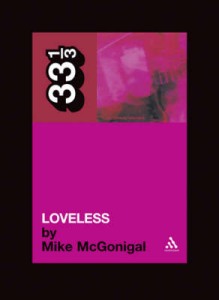
Though the numerous delays that marked the slow-crawl publication of Mike McGonigal’s entry on My Bloody Valentine’s Loveless are amazingly appropriate given the book’s subject, I worried about whether the book would justify the delays. Well…
McGonigal simply tries to do too much. I would have been happy with a detailed account of the recording sessions, but McGonigal skips between his memories of the band’s live show, the interpersonal discord, the label issues, the aesthetic touchstones (in a goddamn top ten list in the middle of the book), “where are they now,” the notable followers, a stripper dancing to “Sometimes,” his connections to the I Love Music board (really), and his short reviews of the songs. There’s a chapter essentially on Rafael Toral’s Wave Field. Loveless (the album) has such a massive mythology surrounding it that 117 pages isn’t enough to go in-depth about all of these topics, even if the inclination is that all of them (well, most of them) need to be discussed. Are there interesting facts in almost all of these categories? Sure. Would the book have been a more compelling read if he had cut a few of them out? Yeah.
Perhaps the cause of the book’s topical happy feet is Kevin Shields, who consented to interviews for the project but frequently comes off of as a frustrating interview subject. While he does his fair share of debunking myths and giving insights into this particular recording process, many of his answers deny one thing without filling in the actual information. When asked about lyrics, for example, Shields laughs about how massively incorrect the various online transcriptions are and then avoids giving any examples of the actual lines. There’s a myth to debunk and a myth to maintain, after all. The other members of the band give far less, if any input (Colm O’Ciosoig did not contribute). Yes, Loveless is Shields’ album, but hearing about his thought process from the others involved, especially Bilinda, is frequently insightful.
Rather than close the book with the dishearteningly vague possibility of a reunion/follow-up record (which he even notes wasn’t his original ending), series editor David Barker told McGonigal that a more upbeat ending would help the text. Oh. After that point, McGonigal gets self-referential about the project, recognizing that “I know this is a short book…” before stumbling onto Loveless’s critical legacy and then a final chapter on that Toral album. What is this, A.I.? I understand Barker’s impetus for a different ending, but having three separate, disjointed endings and discussing each as such is rather infuriating.
Despite the overly broad scope of the book, Shields’ gentle posturing, and the stuttering conclusion, Loveless (the book) still has moments that spur my genuine interest. Hearing briefly about O’Ciosoig’s illness, depression, and eviction during the recording process made me understand why he’s essentially a digitized ghost on the album. Reading about how Deb Googe had almost no part in the recording process clarified her later fronting role in Snowpony. Finding out about Bilinda’s dissolving relationship with Shields and her son from a previous relationship gave shape to her frequently amorphous voice. McGonigal had a fairly thankless role in writing about such a mystified album, but I wish more of the book had focused on the points of interest rather than baffling semi-tangents.
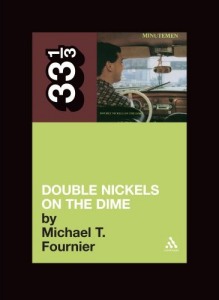
In contrast to an underwhelming entry on an album I love, Michael T. Fournier’s entry on the Minutemen’s Double Nickels on the Dime did exactly what I hoped it would: stoke my interest in an album I’m not nearly as familiar with. Between the conversational insights on the songs from years of listening, the discussions with Mike Watt, and the close readings of the songs’ topical and musical motifs, Fournier makes the forty-five-song behemoth seems entirely approachable.
Although the book’s organization (chapters on each side of the album, specific discussions of the songs in order) seems considerably more straightforward than the books on Doolittle and Loveless, this structure allows Fournier to establish the thematic ties of each side and of the record as a whole while keeping the focus on the individual songs. While Fournier encourages skipping around to read about your favorite tracks on the album, reading about them in the context of each band member’s side helps makes sense of how D., Mike, and Georgie each operated. Thinking about the record in terms of the “fantasy draft” (each band member picked the songs for their side and left the rest for the “Side Chaff” ) is endlessly entertaining for me, given my fondness for fantasy hockey, but it also establishes who prefers which songs and why.
This structure is held together by a deluge of information from a variety of perspectives. Thinking about who wrote which songs (many were contracted out to the band’s friends to keep things fresh), which bands influenced particular songs (whether funk or Wire), and the political commentary of specific tracks keeps the book moving along, but deeper insights like Mike Watt’s admission of the influence of Joyce’s Ulysses on a number of his songs made me sit up and take notice.
Fournier doesn’t dwell much on the band’s fate, avoiding McGonigal’s urge to append ending after ending. While I wouldn’t have minded a post-Double Nickels on the Dime summary after the final chapter, the book seems complete without it since Fournier contextualizes the album within the band’s larger catalog. The best course of action would be to watch the Minutemen documentary, We Jam Econo, to fill in the biographical gaps and to feel the sweat of the band’s live performances and then read the book to truly embrace the individual songs.
Michael T. Fournier’s Double Nickels on the Dime accomplishes the two feats all of these books should aim for: bolster my knowledge about an album and make me want to hear it again. After finishing the book, I wanted to skip through the record and listen to “West Germany,” “June 16th, “No Exchange,” “The Politics of Time,” “History Lesson Part II” and countless others while re-reading sections of the book. Oh, but I also wanted to listen to each side as such and then listen to the album as a whole. I can’t say that I felt the impulse to hear more than a few songs of Loveless again after finishing that book and certainly didn’t twitch to re-read the book itself.
I imagine that I’ll read a few more of the 33 1/3 books over the next few months (the entries on David Bowie’s Low, the Rolling Stones’ Exile on Main St., and Guided by Voices’ Bee Thousand are all intriguing), but for now I’ll have to do with listening to Double Nickels on the Dime as I flip through the particular notes.
|
|
