
Back in high school I absentmindedly plotted out the Slint / Rodan / Tortoise family tree in the margins of my notebooks. Slint was always the epicenter, but Rodan and Tortoise had an ever-growing number of branches. I practiced this history in isolation, since my geographical location (near Poughkeepsie, NY) might as well have been the moon in comparison to Louisville and Chicago. Thanks to my age and location, I hadn’t actually seen any of these bands yet, if they even still existed by that point. But my obsession willfully ignored this outsider status. Even if Poughkeepsie didn’t have a burgeoning scene, I could memorize the bands, labels, venues, and people of Louisville, Chicago, Champaign, D.C., and Chapel Hill.
Unlike the hard-and-fast plots in my notebooks, scenes don’t linger in stasis. This point was made clear my first night in town upon moving to Champaign for college when I attended Braid’s (then) last show. A week later, I missed C-Clamp’s last show in town, hearing about it a few weeks later. Castor was gone, Hum was effectively gone, Honcho Overload and Love Cup were long gone. The scene wasn’t dead—my first English class was taught by Matt Mitchell, the guitarist for Rectangle (a band I’d later see almost a dozen times and help with the artwork for their sophomore release)—but there was no doubt it had changed. I knew this fact going in, but I learned it fresh again and again as new bands formed, old bands broke up, venues opened and closed, labels went dormant, record stores closed, and, most routinely, people moved away. The names change, but the pattern remains.
Michael T. Fournier’s debut novel, Hidden Wheel (named after a Rites of Spring song), runs on this pattern. An art scene pops up in the university town of Freedom Springs, fueled by a few genuine talents, a driven promoter, some historical ties, and an underpinning of second-tier bands, sketchy venues, and outside fascination. The specifics merit a family tree of their own: former chess prodigy (and dominatrix) Rhonda Barrett creates enormous autobiographical canvases, which are then promoted by Ben Wilfork, a former Chicago scene kid who opens an art gallery / performance space. In turn, bands like Stonecipher, a collaboration between an ex-Dead Trend bassist (more on them later) and quickly improving drummer Bernie Reese, and artists like Max Caughin, who paints on discarded CD cases, gain interest. This scene is documented via interviews, journals, tour diaries, press clippings, and show flyers in an academic overview some 300 years later (!), with footnotes explaining what these archaic physical and digital formats were.
That’s admittedly a ton to process at first, like being introduced to the Rodan family tree with an Everlasting the Way single and knowing you need to hear everything else, too, but it’s important to get to the details. As you might expect from someone who taught punk rock history at Tufts, Fournier drops in enough wry references to connect Freedom Springs mythology to the larger world. To wit: Dead Trend was Freedom Spring’s founding hardcore group who went through constant line-up changes (six bassists, three drummers), evolved into a “Buddhist rap-metal” group, and went back to the basics for their reunion tour. The book includes a few flyers for their shows, including a Photoshopped billing with Operation Ivy that recalls a similar move in Jud Jud’s liner notes. Dead Trend is fictional—mostly—but it’s hard not to read Bad Brains and Black Flag into their history. Nautically obsessed math-rock group Coxswain is a proxy for June of 44, with mock lyrics like “Stem and stern! Cape of Hope! Humble spice! Periscope!” jabbing at “Sharks and Sailors.” Venues like Chicago’s Lounge Ax and Cambridge’s Middle East are worked into the story. Even recent Boston band Ketman gets a quick nod.
Fournier also excels at depicting the daily grind of scene life. Living in communal houses, working shit jobs, eating at ill-maintained burrito huts, having brief romantic relationships with other members of the scene, conversing about the importance of vinyl, scraping together enough money to record an album that people are just going to steal off the internet anyway—the names and places in Hidden Wheel may be fictional, but those points will be familiar to anyone who’s attended a show in the basement of a punk rock house.
Hidden Wheel could have simply been a de facto memoir, smudging the details on Fournier’s time at Three Wadsworth in Allston via Bernie Reese’s journals, but two things keep it closer to fiction. First, Rhonda Barrett’s artistic output is the center of this scene, not Stonecipher or Coxswain, and the drive of the narrative is seeing how the events of her life brought her to create her autobiographical canvases and why future scholars would still be interested. Second, those footnotes from the future add a perspective beyond merely commenting on the changes in content delivery. The idea of people still caring enough about this scene 300 years after the fact to document it (noting that the Library of Congress has a copy of the Stonecipher LP in its archives) is a slick validation of this sub-culture.
One intriguing wrinkle: ostensibly fictional band Dead Trend isn’t that fictional after all. Fournier plays drums in the group, who’ve posted some acoustic demos of their vintage ’80s hardcore songs on Bandcamp and have an official 7” coming out soon. Less surprising: they hate Reagan, love the Minutemen, and, in true ’80s hardcore fashion, will likely fit eight songs on that single. Whether they stick around long enough for a Buddhist rap-metal phase is up for debate, but the real-life existence of Dead Trend makes Hidden Wheel an open dialogue on scenes like Freedom Springs. It’s part promotional gimmick for the novel and part DIY statement, recognizing that you can always switch from outsider to insider.
Hidden Wheel is a compelling complement to Michael T. Fournier’s enthusiastic and informative 33 1/3 on the Minutemen’s Double Nickels on the Dime. Whereas Double Nickels is a factual account of one band, one record, one town, Hidden Wheel generalizes the appeal and histories of scenes like Louisville and D.C., recognizing the familiar pattern driving those DIY spaces and local record labels and recreating it as a narrative. Fournier recognizes that scenes are forged by the energy of the people involved and remembered by the artistic tomes they leave behind, and nails both perspectives. It's managed to make me excited about albums both real and fake, which is no small achievement.
Keep an eye on Fournier’s Tumblr for upcoming Hidden Wheel readings and Dead Trend live shows. The latter will be at O’Brien’s in Allston on April 28th; don’t miss the chance to be a part of semi-fictional history.
|

Is it possible to undersell Brian Eno? Between his involvement in the creation and/or production of a towering stack of classic albums and his semi-accurate statements that he invented ambient music, * his legacy speaks volumes for itself. But therein lies the most wonderful aspect of Brian Eno fandom: there’s always more to find. Between his rock-oriented solo albums, ambient albums, world music–informed albums, and a steady stream of collaborations of all three varieties, not to mention those essential producer credits, Eno’s relentless creativity provides seemingly unlimited avenues to explore, especially if you enjoy differentiating between minimal ambient landscapes.
This broad swath of material is often bound together through the mythology of Eno, embodied by those Oblique Strategies cards he created in 1975 with Peter Schmidt. Yet sifting through the mythology (often self-created, since Eno’s a master of subtle self-promotion) to reveal the history is quite rewarding. I caught a glimpse of him at work in Hugo Wilcken’s excellent 33 1/3 volume on David Bowie’s Low, but that’s just one brief segment of Eno’s career. Fortunately David Sheppard’s well-researched On Some Faraway Beach fills in most conceivable gaps in this knowledge, documenting Eno’s upbringing, his aesthetic shaping in art school, his tenure in Roxy Music, his ventures into heavily collaborative solo recording, his high-profile production duties, and his more recent forays into visual art and political commentary. Have I mentioned the women? It documents them quite well.
Much like the Zane Grey biography I proofread for the University of Illinois Press (a remarkably entertaining read even if you care nothing about the pulp Western author), On Some Faraway Beach’s biggest revelation is its subject’s sexual appetites. I’d assumed that Bryan Ferry’s debonair profile received most of the female attention in Roxy Music, but Eno’s flamboyant style and more extroverted demeanor earned him the lion’s share of female attention. It even contributed to the strife between the two that eventually led to Eno leaving/being forced out of the group. The details of Eno’s lust—his supposed appearances in a few pornographic films prior to his musical fame, his vigor and stamina keeping his unfortunate tour roommate up all night, the Polaroid photos which catalogued his conquests, the autobiographical origins of “The Fat Lady of Limbourg”—can be difficult to reconcile with the calm beauty of Music for Airports, but it certainly makes sense with the more graphic allusions of his first two albums. Eno’s romantic life has some less sordid details as well, including writing the lovely “I’ll Come Running” for his then-girlfriend Ritva Saarikko (a Finnish photographer who took the cover portrait for Before and After Science) and the ongoing personal and professional success of marrying his manager, Anthea, in 1988. Perhaps the most revealing anecdote is a quick story about Eno’s flirtations with women on New York City streets in the late ’70s, approaching random strangers with semi-systematic approaches.

That idea of strategic chance dominates the discussion of Eno’s own music and production duties. Beginning as an avowed non-musician musician, Eno picked up second-hand tape recorders en masse to see how each one varied in sound. By the time he joined Roxy Music, he was quite adept at plumbing the depths of his synthesizer for new sounds, if still naïve of musical theory. Much of his solo work relies on three conditions: bringing in talented collaborators, challenging them to leave their usual approaches behind, and forcing himself to think on the spot. This emphasis on process resulted in both the pruned beauty of Another Green World and the elongated, frustrating genesis of Before and After Science; the improvisational collaboration with Robert Fripp on No Pussyfooting (which cost practically nothing to record and yet sold as astonishing 100,000 copies) and the detailed collages of My Life in the Bush of Ghosts with David Byrne; the ease of working with Daniel Lanois and brother Roger Eno on Apollo: Atmospheres and Soundtracks and the contentious work with John Cale on Wrong Way Up. What On Some Faraway Beach stresses is the variety of these situations: sometimes Eno turns on a loop machine and records an ambient classic with infuriating ease, other times he tinkers endlessly on the final product.
Eno’s production career shares this range of process-dictated success, with the key variables being the artists’ willingness to experiment and the level of additional help Eno had in the studio. I was quite surprised to learn that Devo—having gallingly declared that their debut LP would be recorded by either Brian Eno or David Bowie (who’d agreed, only to back out due to scheduling conflicts)—were the most resistant to Eno’s oblique strategies, with Mark Mothersbaugh later regretting their know-it-all attitude. On the opposite end of the spectrum, Eno’s heavy involvement in Talking Heads’ Remain in Light might be the most artistically fruitful and hands-on record on his credit sheet, going so far as Eno’s request that the album be credited to “Talking Heads and Brian Eno” (after all, he wrote the vocal melody for the chorus of “Once in a Lifetime”!), but Tina Weymouth and Chris Frantz hardly shared David Byrne’s brotherhood with Eno. Weymouth even went as far as reinserting her deleted bass performances after Eno left the board. Eno’s involvement with Bowie’s Berlin Trilogy finds a healthy middle ground between these poles. With Tony Visconti helming the sessions for Low, “Heroes,” and Lodger, Eno was free to come in for a few days, challenge the status quo of the recording sessions, and leave once things had been adequately toppled. By Lodger this arrangement had lost some of its spontaneity, but Bowie lauded Eno’s involvement and eventually collaborated with him again on 1995’s Outside.
On Some Faraway Beach loses steam once it hits the mid-80s, specifically with the discussion of his involvement on U2’s albums. While those albums—particularly The Unforgettable Fire, The Joshua Tree, and Achtung Baby—provide enough interesting anecdotes (like Eno getting so sick of the endlessly fussed-over “Where the Streets Have No Name” that he nearly trashed the master tape or the fact that the infinite sustain guitar the Edge played on “With or Without You” was one of just three in the world) to keep me moving along, the depth of the treatment doesn’t match the earlier eras. Condensing the 20+ years from The Unforgettable Fire to the completion of the book in 2008 to a mere 70 pages results in too many projects getting tossed into veritable laundry lists. To wit: Eno’s involvement in Slowdive’s Souvlaki receives a mere half-sentence of discussion. Whether it or countless other projects from the ’90s and ’00s deserve equal attention to, say, Remain in Light is debatable (one I pick up in a review of Music for Films III), but it’s impossible not to feel the rush of wind when Sheppard puts the pedal to the floor.

Given Eno’s remarkably prolific nature, the lack of a discography appendix is disappointing, specifically because On Some Faraway Beach: The Life and Times of Brian Eno piqued my interest in so many of his albums—both familiar and unfamiliar. This discography provides a good start, but Sheppard’s informed opinions into these albums provide a wonderful road map, as long as you’re willing to do some serious flipping back and forth with the index and add a bunch of entries to your musical shopping list.
Don’t dawdle on these shortcomings. On Some Faraway Beach hits all the right big notes—it contextualizes Eno within the various phases of his career, it reveals the strategic choices behind some of his best work, it illuminates the corners of his very long, very storied career–and most importantly, it provides countless “Did you know?” anecdotes for your next Eno-themed dinner party. (The most curious fact? Both Brian Ferry and Elton John auditioned for King Crimson’s vacant vocalist slot in 1971.) Almost assuredly you have some form of an “in” for Eno’s catalog, and unless it’s one of his later albums or production jobs, On Some Faraway Beach is bound to increase your appreciation of it. Trust me—I spent a solid two weeks listening to Another Green World over and over again, marveling at one of my favorites with renewed interest.
* Here’s my take on whether Eno invented ambient music: No and yes. No, he was not the first or the only person to come up with the idea of passive listening. Erik Satie coined the term “furniture music,” contemporary composers like John Cage, La Monte Young, Steve Reich, and Terry Riley became practitioners of particular forms of it. But if we’re talking about the roots of modern ambient music—the minimal landscapes of Stars of the Lid, Labradford, Eluvium, etc.—or “chillout” electronic music, yes, Eno is the primary forefather of those movements (if by no means the sole influence). Coining the term “ambient music” certainly helps his case.
|

I first noticed that Continuum had chosen an author for a 33 1/3 book on a Wire album when I was checking out who else on Last.FM was obsessively listening to early Colin Newman solo records. Lo and behold, one of my fellow devotees had been slotted to write the book about Pink Flag. This moment occurred shortly after I’d narrowed down the records that I could conceivably write 33 1/3 books about—barring all of my preferred options that would never be accepted (Juno, Shiner, Hum, Castor, Jawbox, Silkworm, Shudder to Think)—to Wire and Slint albums, with the possible addition of Girls Against Boys’ Venus Luxure #1 Baby, so reading his announcement was bittersweet, just like it’ll be when someone is chosen to write about Spiderland.
I can understand why Continuum chose Pink Flag, since it probably has the largest cross-over appeal of the three early Wire records, even though I would have opted for either the post-punk perfection of Chairs Missing or the unrelenting progress of 154. Whereas those two albums are firmly in the post-punk camp, Pink Flag occupies a liminal space between punk and post-punk, a concept that Wilson Neate investigates during the first half of the book. While no one explicitly stated this viewpoint in the book, I’m sure there are punk-rockers out there who love Pink Flag but have no time for either Chairs Missing or the willfully difficult 154. Those punk rockers and their post-punk peers will be well served by Neate’s book.
Neate’s Pink Flag is divided in two rough halves: the first five chapters are devoted to biographical, historical, and contextual coverage and the massive sixth chapter provides commentary on each song. Considering that Kevin Eden’s Everybody Loves a History speeds through much of this period in order to give equal space to the group’s post-Wire output and post-reformation material, Neate’s thorough exploration of Wire’s early years is quite welcome. Eden’s book glosses over George Gill’s tenure in the group, but Neate emphasizes how Gill’s clichéd rock ‘n’ roll approach gave the other four members something to model their minimalist approach against. The Clash provided a similar model, which led to some cold interactions between the groups. Wire? Cold? Never!
Doing the song-by-song approach works for some 33 1/3 books (Double Nickels on the Dime in particular) and it could have easily been the bulk of this book, given that Pink Flag has 21 tracks and the chapter spans 60 pages. Neate notes how several correspondents had difficulty extracting favorites from this string of songs, viewing it more as one complete document, which I can understand to some extent. Certain songs—“Reuters,” “Ex-Lion Tamer,” “Pink Flag,” “Mannequin,” “12XU”—stick out to me, but there’s a string of others, especially on side B, that flow together. Reading about them as separate songs shortly after I’d listened to the record was quite interesting, but I still had a hard time remembering a few of the songs’ melodies.
The post-script is relatively limited, jumping from just after Pink Flag to Elastica’s appropriation of “Three Girl Rhumba,” to that song’s use in a British H&M ad, and finally to Bruce Gilbert’s self-removal in 2004. It’s a transition focused on the financial side of the band, in which Colin Newman redid the writing credits for Pink Flag to give himself more royalties (he’d written the majority of the guitar parts, but Bruce Gilbert played most of them on the recording). Neate makes the point that the rock side won out over the art side, which is quite clear to anyone who’s read Object 47, Wire’s first post-Gilbert LP. Bits of Wire’s post-Pink Flag history are sprinkled throughout the book, but don’t expect any emphasis on “Outdoor Miner” or “The 15th.”
My biggest critiques are editorial in nature. At 150 pages, Pink Flag is on the long side of 33 1/3 books, surpassed in my stack by only the tomes on Bee Thousand and Exile on Main Street. The length would be fine if not for thematic repetition in the first half of the book, in which various points (Wire’s minimalism in particular) are reinforced several times over by multiple quotations. Graham Coxon provides an undue amount of these quotations, which baffles me in the presence of Albini, MacKaye, Prescott, Rollins, Watt, etc. Ultimately, Pink Flag the book would have benefitted from some of Pink Flag the album’s signature economy.
Despite these minor caveats, Neate does an excellent job bringing a Wire album to the 33 1/3 canon, finding a similar level of success to Bob Gendron’s Gentlemen. I doubt that most fans have tracked down Everybody Loves a History, but Pink Flag is a more succinct, more focused option for those who do not care to read about the genesis of The Ideal Copy. I’m holding out hope that Wire is granted one or two more entries in the 33 1/3 series, since Chairs Missing and 154 deserve equal treatment, but barring a major shift in Continuum’s approach, that’s not going to happen, so go pick up Pink Flag.
|
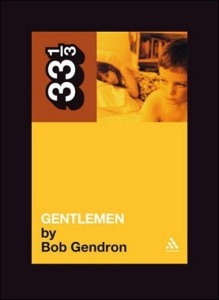
In the growing stack of 33 1/3 books sitting on my desk hutch, five of the albums covered made my Record Per Year list (the Rolling Stones’ Exile on Main Street and David Bowie’s Low might’ve joined this list if I had been born a decade earlier). Yet the Afghan Whigs’ Gentlemen sticks out as the album I was most excited to read a book about, owing to a combination of the Whigs’ comparatively relative fame (or perhaps, more appropriately, infamy), the deep-rooted emotional attachment I have for the record, and the strange circumstances involving my acquisition of a copy. I was a freshman in high school when I heard “Debonair” and “Gentlemen” on WDST, Radio Woodstock, but it took one of my friends mistakenly getting a copy of Gentlemen from BMG Music Club and then trading it to me for five bucks and an extra Obi-Wan Kenobi action figure for the album to make it into my hands. Trading a youthful artifact for Greg Dulli’s seedy, adult world and unrelenting self-flagellation seems like the devil’s own recipe for adolescent disaster, but even without a trace of the album’s sex and drugs, I was able to transfix my high school alienation to Gentlemen’s post-graduate despair.
I knew that Bob Gendron—a writer for the Chicago Tribune and editor of The Absolute Sound and Playback—was tabbed to write a 33 1/3 volume on Gentlemen, but its appearance in the Harvard Book Store took me by surprise. Unlike the lengthy delay for Mike McGonigal’s Loveless (which hardly lived up to the wait), Gentlemen snuck up on me and did not disappoint. Like the other volumes in the series that I’d recommend without hesitation—Michael T. Fournier’s Double Nickels on the Dime and Hugo Wilcken’s Low—I tore through the 114 page volume in a single sitting and immediately pulled out the album for a dedicated listen.
Gentlemen falls in line with more traditional 33 1/3 entries, covering the band’s back story, the album’s creation, the critical response, and the enduring legacy in lieu of a central conceit like Joe Pernice’s coming-of-age novella Meat Is Murder or Kate Schatz’s presumably catharsis-driven Rid of Me: A Story, but Dulli’s relationship trauma and coke binges hardly require fictional ballast. Solid coverage is given to the group’s early days on Sub Pop, but Gentlemen wouldn’t exist without the conscious decision to separate themselves from their flannel-clad peers and the lingering stain of the “soul grunge” label. Yet the core of the book comes with the investigation of Dulli’s relationship with Kris, which prompted the album’s conceptual focus, and the subsequent substance abuse. One night during the recording session in Memphis, a local stripper that Dulli brought back to the studio witnessed the coke-addled singer rip through final takes of five of the album’s songs. While the titillation of Dulli’s infidelities and drug usage reminds me of how entertaining the Replacements and Butthole Surfers chapters of Michael Azerrard’s Our Band Could Be Your Life were in comparison to chapters on preferred acts like Dinosaur Jr. and Mission of Burma, Gendron’s discussion of the group’s soul influences and fallout with Elektra Records is just as memorable. I had no idea that Terry Tolkin, the A&R man at Elektra, was partially behind the infamous Fat Greg Dulli fanzine, but this post at A Deeper Shade of Soul helps elucidate that particular topic with further comments from Dulli’s close friend, actor Donal Logue. (I remember the two of them hosting 120 Minutes and reenacting scenes from their favorite movies—I could only wonder if dudes got much cooler than them.)
My quibbles are minor. The opening of the book suffers from an awkward transition from Dulli’s near-death experience following an attack in an Austin night club in 1998 to a description of Dulli’s gallivanting playboy ways, but I prefer the former event being covered at the start of the book as opposed to the end. Gendron’s occasional dismissals of recent music trends might date the book, like a mention of the Juno soundtrack as an example of the lingering prudishness of indie/alternative rock, but I can’t harbor resentment about Gendron’s longing for the days of LP artwork in favor of iTunes thumbnails given my overwhelming preference for vinyl. The dismissal of Black Love in two short paragraphs as a bloated album choosing instrumental glut over clear melodies underscores Gendron’s clear preference for its predecessor, but I have little doubt that Black Love is the second-best Whigs album. My biggest complaint is actually a compliment in disguise: I simply wanted more.
Reading that Gentlemen sold only 160,000 copies and never cracked the Billboard Top 200 made me feel lucky to own a book on such a personal favorite. He also mentioned that few publications put the album in their top 10 lists for 1993 and Pitchfork’s Top 100 of the 1990s lacks even a mention of the group, but those critical blind spots made me proud to mention that Gentlemen was #33 in the Signal Drench 100 of the 1990s. (It would rank even higher in my personal list.) The Afghan Whigs have been a love-’em-or-hate-’em proposition, but those in the former camp would be wise to track down Gendron’s Gentlemen.
|
|
Although I’d previously only read one of the 33 1/3 books from cover to cover—Ben Sisario’s solid, if unspectacular tome on the Pixies’ Doolittle—I’ve had my eyes on a few of them over the last few months, eagerly waiting for the available time to read something other than critical theory. I skimmed through a handful of the books today at the Harvard Book Store, opting for entries on Loveless and Double Nickels on the Dime (which was written by my ’90s-indie-rock-lovin’ doppelganger, Michael T. Fournier). Despite running into Mike at the Newbury Comics in Harvard Square shortly after purchasing his book (“It’s funny I ran into you… guess what I just bought?”), I somewhat arbitrarily opted to read his book second, perhaps because I’d been waiting to read the other book for some time. Just like I’ve been waiting for a My Bloody Valentine record for some time. Imagine that.

Though the numerous delays that marked the slow-crawl publication of Mike McGonigal’s entry on My Bloody Valentine’s Loveless are amazingly appropriate given the book’s subject, I worried about whether the book would justify the delays. Well…
McGonigal simply tries to do too much. I would have been happy with a detailed account of the recording sessions, but McGonigal skips between his memories of the band’s live show, the interpersonal discord, the label issues, the aesthetic touchstones (in a goddamn top ten list in the middle of the book), “where are they now,” the notable followers, a stripper dancing to “Sometimes,” his connections to the I Love Music board (really), and his short reviews of the songs. There’s a chapter essentially on Rafael Toral’s Wave Field. Loveless (the album) has such a massive mythology surrounding it that 117 pages isn’t enough to go in-depth about all of these topics, even if the inclination is that all of them (well, most of them) need to be discussed. Are there interesting facts in almost all of these categories? Sure. Would the book have been a more compelling read if he had cut a few of them out? Yeah.
Perhaps the cause of the book’s topical happy feet is Kevin Shields, who consented to interviews for the project but frequently comes off of as a frustrating interview subject. While he does his fair share of debunking myths and giving insights into this particular recording process, many of his answers deny one thing without filling in the actual information. When asked about lyrics, for example, Shields laughs about how massively incorrect the various online transcriptions are and then avoids giving any examples of the actual lines. There’s a myth to debunk and a myth to maintain, after all. The other members of the band give far less, if any input (Colm O’Ciosoig did not contribute). Yes, Loveless is Shields’ album, but hearing about his thought process from the others involved, especially Bilinda, is frequently insightful.
Rather than close the book with the dishearteningly vague possibility of a reunion/follow-up record (which he even notes wasn’t his original ending), series editor David Barker told McGonigal that a more upbeat ending would help the text. Oh. After that point, McGonigal gets self-referential about the project, recognizing that “I know this is a short book…” before stumbling onto Loveless’s critical legacy and then a final chapter on that Toral album. What is this, A.I.? I understand Barker’s impetus for a different ending, but having three separate, disjointed endings and discussing each as such is rather infuriating.
Despite the overly broad scope of the book, Shields’ gentle posturing, and the stuttering conclusion, Loveless (the book) still has moments that spur my genuine interest. Hearing briefly about O’Ciosoig’s illness, depression, and eviction during the recording process made me understand why he’s essentially a digitized ghost on the album. Reading about how Deb Googe had almost no part in the recording process clarified her later fronting role in Snowpony. Finding out about Bilinda’s dissolving relationship with Shields and her son from a previous relationship gave shape to her frequently amorphous voice. McGonigal had a fairly thankless role in writing about such a mystified album, but I wish more of the book had focused on the points of interest rather than baffling semi-tangents.

In contrast to an underwhelming entry on an album I love, Michael T. Fournier’s entry on the Minutemen’s Double Nickels on the Dime did exactly what I hoped it would: stoke my interest in an album I’m not nearly as familiar with. Between the conversational insights on the songs from years of listening, the discussions with Mike Watt, and the close readings of the songs’ topical and musical motifs, Fournier makes the forty-five-song behemoth seems entirely approachable.
Although the book’s organization (chapters on each side of the album, specific discussions of the songs in order) seems considerably more straightforward than the books on Doolittle and Loveless, this structure allows Fournier to establish the thematic ties of each side and of the record as a whole while keeping the focus on the individual songs. While Fournier encourages skipping around to read about your favorite tracks on the album, reading about them in the context of each band member’s side helps makes sense of how D., Mike, and Georgie each operated. Thinking about the record in terms of the “fantasy draft” (each band member picked the songs for their side and left the rest for the “Side Chaff” ) is endlessly entertaining for me, given my fondness for fantasy hockey, but it also establishes who prefers which songs and why.
This structure is held together by a deluge of information from a variety of perspectives. Thinking about who wrote which songs (many were contracted out to the band’s friends to keep things fresh), which bands influenced particular songs (whether funk or Wire), and the political commentary of specific tracks keeps the book moving along, but deeper insights like Mike Watt’s admission of the influence of Joyce’s Ulysses on a number of his songs made me sit up and take notice.
Fournier doesn’t dwell much on the band’s fate, avoiding McGonigal’s urge to append ending after ending. While I wouldn’t have minded a post-Double Nickels on the Dime summary after the final chapter, the book seems complete without it since Fournier contextualizes the album within the band’s larger catalog. The best course of action would be to watch the Minutemen documentary, We Jam Econo, to fill in the biographical gaps and to feel the sweat of the band’s live performances and then read the book to truly embrace the individual songs.
Michael T. Fournier’s Double Nickels on the Dime accomplishes the two feats all of these books should aim for: bolster my knowledge about an album and make me want to hear it again. After finishing the book, I wanted to skip through the record and listen to “West Germany,” “June 16th, “No Exchange,” “The Politics of Time,” “History Lesson Part II” and countless others while re-reading sections of the book. Oh, but I also wanted to listen to each side as such and then listen to the album as a whole. I can’t say that I felt the impulse to hear more than a few songs of Loveless again after finishing that book and certainly didn’t twitch to re-read the book itself.
I imagine that I’ll read a few more of the 33 1/3 books over the next few months (the entries on David Bowie’s Low, the Rolling Stones’ Exile on Main St., and Guided by Voices’ Bee Thousand are all intriguing), but for now I’ll have to do with listening to Double Nickels on the Dime as I flip through the particular notes.
|
|
I added Dustin Long’s Icelander to my Amazon wish list after stumbling upon his Listmania entry on “Books that you might like.” The first two entries—Nabokov’s Pale Fire and Flann O’Brien’s The Third Policeman—provide much of the blueprint for Icelander, a postmodern satire of literary authorship in the guise of a murder mystery. The first third of the novel suffers from this tribute; the footnotes add little to the actual text, interrupting an already slow-building narrative. Once Long opts to rotate the narrative perspective, however, Icelander begins to take better shape, setting “Our Heroine” against a number of other voices, some (Blaise Duplain) more compelling than the protagonist. Unlike some of the other indebted literary devices, the rotating cast of narrators feels natural, allowing for smoother shifts between storylines and helping to establish the mythological framework for his imagined community. This section also builds momentum for the resolution of the murder mystery, which may actually be more successful than its postmodern frame narrative.
I hand it to Dustin Long for choosing difficult texts to emulate and managing to be largely successful in applying their modes to his project. Even though Icelander isn’t as pointedly funny as The Third Policeman or as structurally refined as Pale Fire, few books are. Icelander is a worthy read for fans of those authors, but I hope for a much-improved second novel, one not so dominated by the spot-the-allusion game. If you’re on the edge on whether Icelander worth checking out, the hardcover edition of Icelander has a nicely embossed dust jacket–free cover and shames most of its neighbors on my bookshelf. Take that, secondhand D. H. Lawrence hardcovers.
That note provides a nice transition to my other recent read, Michael Chabon’s The Final Solution, since its cover art was featured in Jay Ryan’s 100 Posters, 134 Squirrels: A Decade of Hot Dogs, Large Mammals, and Independent Rock, something I remembered when I saw it in the clearance section of Barnes and Noble. The Final Solution is about an elderly detective’s search for the missing parrot of a mute Jewish boy in 1944, but leaves many of its most successful themes simmering under the surface, foremost whether the detective is actually Sherlock Holmes. It’s a quick read and not as emotionally heavy as the title might suggest, but Chabon’s subtlety helps extent the book past its page count (131 including a handful of illustrations from Ryan).
|
Bulgakov, Mikhail. The Fatal Eggs. 104 pp.
Greene, Graham. The End of the Affair. 238 pp.
Nabokov, Vladimir. Ada. 626 pp.
Nabokov, Vladimir. Glory. 205 pp.
Nabokov, Vladimir. Laughter in the Dark. 292 pp.
The sparring of my two tasks—completing my initial reading list and tackling my newfound task of reading all of Nabokov’s novels—isn’t much of a match at this point, but I’m still chiseling away at both. The Fatal Eggs meets neither qualification, but in lieu of reading Flight and Bliss, I decided to read Bulgakov’s scientific/political satire. Like Heart of a Dog, the novella length prevents Bulgakov from truly inhabiting his characters, but allows for more direct cultural critique. The vision of enormous snakes crawling their way to Moscow could inspire a sequel to Snakes on a Plane (which I’m boycotting in theaters; I’d far prefer to go laugh at a movie when other people might possibly be taking it seriously, cough, Alien vs. Predator), but the social repercussion of scientific advances is still relevant. Worth the quick read.
The End of the Affair marks one of those awkward instances of having seen a film adaptation first (the 1999 Julianne Moore version; I’m not sure how well I could handle seeing a young Grand Moff Tarkin play Henry Miles), but that viewing was a few years ago and it didn’t taint the experience of the novel. Infidelity and jealousy have been fairly consistent themes in the Nabokov segment of this reading list, but the resounding sincerity and religious implications at work here made the two worlds seem almost entirely foreign. Those in charge of Greene’s collection at BC discussed how he received a deluge of letters from housewives pleading of his advice/permission for such illicit affairs, and could only respond with dry uniformity that he was, in fact, an author, and this story was not based on personal experience. Something tells me they didn’t believe him.
This round’s trio of Nabokov novels started with Ada and I’m not entirely sure where I stand on that novel yet, so I’ll keep my comments to a minimum. The gap between knowing I should reread a novel and chomping at the bit to do so divides Ada from Pale Fire, Bend Sinister, and Pnin, but at this point, I’ll call Ada a compelling, extended meditation and leave it there.
Glory has its moments—Martin’s fistfight with Darwin, the discussion of the value of various academic disciplines, Martin’s realization of his mutable nationality, and particularly its vague, compelling ending—but its drifting nature and (somewhat intentionally) bland characters take it down a notch.
Laughter in the Dark may lack some of the linguistic games and structural complications of Nabokov’s later novels, but once the primary relationship started, I tore through it like a man possessed. Despite his admitted distaste for dialogue, the dialogue, or more precisely, the tiny breathes of internal monologues poking through the dialogue, is where Laughter truly shines, honing its bleak tone to perfection. I understand why the Lolita comparisons arise, but the strength of Laughter is that tone rather than rapturous prose, separating the two novels somewhat significantly in my mind.
|
|
Five more books, zero from the list.
Banville, John. Ghosts. 245 pp.
Heaney, Seamus. The Burial at Thebes. 79 pp.
Nabokov, Vladimir. Invitation to a Beheading. 223 pp.
Nabokov, Vladimir. Transparent Things. 104 pp.
Sisario, Ben. Doolittle. 121 pp.
I picked up a handful of Banville’s novels on the cheap from Half.com when I ordered No Laughing Matter: The Life and Times of Flann O’Brien, but Ghosts is the first of them that I’ve tackled. Banville’s weighty, wordy prose style and the slow-moving drifts of the subject matter are a bit of an odd combination, particularly without the narrative propulsion of Nabokov, but ruminating over the novel after the fact been rewarding, even if the actual reading experience seemed . Given that I just found out that this is the second book in a trilogy (along with The Book of Evidence and Athena, neither of which I own), some of my problems with the novel—foremost how the shadows of character development were both intriguing and somewhat infuriating—are thrown out of the window.
It’s tough to get away from Nabokov, in part because I keep picking up his novels from the library, the book store, or the library book sale, but this pair kept my momentum going. Transparent Things is a successful novella, relatively compelling in its brief length without seeming incomplete. Invitation to a Beheading covers some of the same thematic ground as Bend Sinister, but resides almost exclusively in the prison setting. It isn’t as griping or quite as allusive as that novel, and if you’re going to read one, Bend Sinister is the obvious pick, but Invitation is an excellent alternate pathway to travel. I’m stunned that I didn’t glance at the back cover before finishing the novel—I purchased the book after having read a brief description online—but completely thankful for this, as it gives away every major plot point in the novel. If not for Nabokov’s somewhat neurotic musings (this time it’s about how the novel is always thought of as being inspired by Kafka, yet Nabokov hadn’t read any Kafka prior to writing it), I’d be able to give up reading introductions, forewords, prefaces, et al, altogether.
Burial at Thebes takes an entirely different poetic approach than Heaney’s more famous translation/reimagining of Beowulf, cutting down on the kennings and emphasizing the readability and direct impact of the text for today’s political climate. In terms of his intentions, it’s successful, but the majority of translations lack the risk/reward factor of Heaney-wulf, especially this one given the contrast. Perhaps I’d have a different verdict if I had seen this performed, but if I’m itching to read some Heaney, it’s still going to be his poetry (North in particular) or his version of Beowulf.
Doolittle is the first entry from the 33 1/3 series that I’ve picked up (Loveless will likely be the next). Unlike some of the other books in the series—Joe Pernice’s semi-fictional prose for Meat Is Murder, for example—this is a fairly straightforward contextualization and explanation of the album’s time period, impact, and themes (primarily Surrealism). Sisario drove around with Frank Black, gathering notes and anecdotes, but perhaps the biggest remnant of this experience is a lingering reticence on the part of Black Francis to discuss the album in detail. The other members of the band have far less input—Kim Deal, as per usual, has none at all—but it’s still a worthwhile read. I really like the idea and aesthetic execution of the series, so hopefully the trend of covering albums I genuinely enjoy will continue.
Jon keeps telling me that I need to write a book for this series on Juno’s A Future Lived in Past Tense, but despite our mutual fondness for this record, I’m not sure if Continuum would be able to justify the expenditure. Juno fans seem to be remarkably rabid individuals, but they have not yet funded a grant for this project. The bittersweet thing about this line of jokes is that I would be both thrilled and somewhat prepared to write this book. If anyone wants to fund a 44 1/4 series covering the finest records from Juno, Shiner, Hum, Jawbox, Shudder to Think, and Castor, please do it.
|
|
I’ve managed to finish five more books, only one of which made my original list. The likelihood of this practice continuing is fairly strong.
Bulgakov, Mikhail. The White Guard. 320 pp.
Maxwell, William. So Long, See You Tomorrow. 144 pp.
Nabokov, Vladimir. Despair. 176 pp.
Nabokov, Vladimir. Pnin. 208 pp.
Nabokov, Vladimir. The Real Life of Sebastian Knight. 206 pp.
I started The White Guard last fall, but it didn’t hook me as much as The Master and Margarita, so it was cast aside in favor of my coursework. Naturally, it didn’t take long for me to get involved with the story this time around, as the combination of historical perspective and autobiographical insight gained momentum after the first quarter of the book. It’s a different reading experience than Master—there are no flights of fancy, rather a resounding core of familial loyalty—but it’s very close in execution and the best of this round.
I had tried reading So Long, See You Tomorrow after proofing a book on William Maxwell, but my attempt stalled before I had to return it to the Champaign library. If I’ve learned anything from my summer reading push, it’s that I’m rarely capable of coming back to a book that I’m not wholly invested in, particularly a “quiet” (the academic term for “non-eventful” or, more bluntly, “boring”) novel. I don’t think this book found its position between fiction and memory until the final few chapters—too much dry exposition in the build-up—but said position was worth returning to this book a few years later. Maxwell’s attempt to find the absent shades of human interaction in a newspaper recap of an unfortunate crime hits its mark when he finally embodies those involved and then rethinks his personal involvement (or lack thereof) in response to this fictionalization. I’m not sure if I’ll read any of his other novels, although I’ve always liked the title of Time Will Darken It, but I do have a collection of his short stories.
The trio of Nabokov books was largely arbitrary, decided by BC library availability and used copy selection. (Invitation to a Beheading and Ada are the next two I’d like to read; The Defense and Glory may take precedence given my newfound ownership of these titles.) The bittersweet wit of Pnin still lingers a few weeks after finishing it, as Nabokov succeeded with the postmodern frame of narrative usurpation and the sentimental resonance of the title character. It’s close behind the previous three Nabokov works I’ve read and high on my re-read pile. In some ways The Real Life of Sebastian Knight seemed like a dry run for the more involved authorial postmodernism of Pale Fire, but that didn’t detract from my enjoyment of the novel. I’d rehash the main themes, but the back of the book does that better than most and I don’t want to plagiarize. Despair, however, broke my habit of not starting a new book before finishing my current title, because the first seventy pages confirmed Nabokov’s introductory note that though Hermann and Lolita’s Humbert Humbert are both “neurotic scoundrels,” “Hell shall never parole Hermann.” I don’t think that the book would have worked if Hermann had a more human core to his actions, but the one-sidedness of the moral landscape of the novel places it a notch below his other works. Despair’s foreword does provide a bit of a laugh when Nabokov notes how “a Communist reviewer (J. P. Sartre)” wrote “a remarkably silly article” about the book in 1939. Parenthesized, ouch. I’m going to try to slow down my personal Nabokov seminar for a bit while I spend time with other authors, but those four I mentioned above are effectively added to the big list.
My reading pace initially benefited from the conclusion of my summer research course, but then we drove through the Midwest for a week and a half, effectively killing that momentum. Driving and reading don’t mix well, but I enjoyed seeing the majority of the readers of this web site for the first time in months. Logging almost 3000 miles has its rewards—I’m trying to keep the veneer of insects on the front bumper as long as possible—but next time I think I’d prefer to Segway across America.
My record shopping adventures didn’t find a remarkable 2006 release that I’d somehow missed (although Cursive’s Happy Hollow has positioned itself in the “very good” stack), but I did manage to pick up some excellent records—a 180-gram LP of the Timeout Drawer’s Nowonmai, the Isis live 2LP, Sufjan Stevens’ Seven Swans LP, and a smattering of new and used CDs. I’ve been tempted to change my top 40 of the 2000s feature to include 2005 releases and some albums I overlooked (one of which I just mentioned!). Don’t wait around for that, but if you’ve been searching for the Signal Drench 100, here it is.
ExplodingNow! is Dusty’s new long-form blog to complement the more direct mp3 blogz0r. I recommend both. Bellevegas.com sells a wide selection of Belleville, Illinois related shirts and features Phil Baker as a model. If you’re looking for my super-secret mp3 directory, maybe you should check here. I'm trying to add more random, rare stuff as I go.
I’ve missed out on much of the NHL off-season excitement during my travels, but as a Red Wings fan, there really hasn’t been too much to get excited about. Steve Yzerman, my favorite athlete, retired, ending his brilliant career. His series-winning slap shot against the Blues in 1996 is my single favorite sports memory. I remember staying up late with my dad to watch the conclusion of that double overtime thriller and being almost as thrilled as Yzerman’s memorable celebration. Perhaps lost in that celebration is how that marked the first (and only) time that Yzerman had beaten Gretzky in a playoff series, having lost to the Oilers in 1987 and 1988. Yzerman’s retirement didn’t come as a surprise by any means, but given that he was the most dangerous player for most of the Wings’ first-round series against the Oilers, I thought that he might stick around. Shanahan moved to the Rangers for four million. Lidstrom is somehow making less money than Zdeno Chara. I’m still holding out hope that the Wings will swing a trade for Jean-Sebastien Giguere or Martin Biron (a trade not involving Kronwall, thanks) and crossing my fingers that Ken Holland doesn’t invest in Belfour or Hasek. I’d rather have Legace back than either of those guys; even if Legace is an easy scapegoat for a disappointing first round, he didn’t implode like Hasek or suffer injuries and setbacks like Belfour.
|
|
Occasionally I fill dead spots in my afternoons by updating my Amazon recommendations. If nothing else, it’s a slight boost of pride when I already own six of the ten items on a given page. But this item, however, I do not own. “Recommended because you said you owned Punch-Drunk Love” is 1989’s Going Overboard, which I have, in fact, not seen, an amazing feat given its positive reviews and box office success. This is not an isolated incident, but the cover just seemed so out of place amid my other recommendations. Amazon, just because I own a James Joyce biography from the Penguin Lives series does not mean that I would be interested in a similarly profile of Pope John XXIII.
As for my summer reading, I’ve finished the following books (in this order). I decided to start with some shorter novels to build momentum and to largely disregard sticking to my initial list in favor of new purchases and library loans.
Nabokov, Vladimir. Pale Fire. 315 pp.
Beckett, Samuel. Watt. 255 pp.
Nabokov, Vladimir. Bend Sinister. 241 pp.
Bulgakov, Mikhail. Heart of a Dog. 123 pp.
McGahern, John. The Dark. 191 pp.
Out of these, I think the Nabokov novels are the most compelling, and if pressed to pick a favorite, I would probably choose Bend Sinister. Unsurprisingly, I’m already onto my next Nabokov, Pnin, and have Despair in the queue. The Bulgakov doesn’t quite match The Master and Margarita, but it has some particularly funny moments, unlike the unpublished Flann O’Brien television plays that I read yesterday. (I’m not including school-related readings or research.) Watt courses with dark humor, but the iterations of every conceivable logical end wore thin and reminded me too much of Gertrude Stein. I also picked up Murphy, but at this point I’m more interested in re-reading his postwar “trilogy,” so it may be a while before I get to it. Finally, the McGahern is an interesting coming-of-age narrative and I certainly grasped what controversial elements led to its banning, but it lacked the comforting rural insularity of By the Lake (That They May Face the Rising Sun abroad).
My goal by reporting these isn’t necessarily to impart any academic insight (I’m actually trying to avoid doing this) or to puff out my chest in a “Look what I’m reading” manner (if anything, I’m embarrassed that I haven’t read most of these yet), but more to have something to report and to keep pushing myself to get through my initial list this summer. Between reading, the NHL and NBA finals, and the World Cup, I haven’t had much time to watch any movies lately, my vocal malaise over this year’s musical output has limited record reviews or summaries, and there’s almost nothing worth watching on television in the summer.
|
|
