|
Matt Talbott is apparently branching out from coaching high school football, since he's joined up with former Shiner members Paul Malinowski and Jason Gerkin (among others) for the next Open Hand record. He's featured on the untitled song at their MySpace page, which sounds like Downward Is Heavenward-era Hum with background vocals replacing some of the riffs. I have no idea if they're all part of the touring line-up or if this song is a one-off, but it bodes well.
Former Doris Henson/Proudentall frontman Matt Dunehoo is now in the NYC band Baby Teardrops. I skimmed a few of the songs, which didn't grab me as much as the highlights of Doris Henson's final record, Give Me All Your Money, but I'll keep an eye out for any official releases.
Bradley's Almanac has talked about Wye Oak on several occasions, so I checked out their Merge debut If Children. Perhaps it's the male/female duo that tipped me, but the record reminds me of a more rustic version of Folksongs in the Afterlife, whose Put Danger Back into Your Life is one of the most underrated records of the decade. Wye Oak has a similar appreciation for varying tempo and approach, although there are no bossa nova joints on If Children. They're playing Great Scott in Allston on May 2nd, but that is the week of too many damn shows, so I may not make it.
The Narrator has posted a song called "So the End" on their MySpace page, which surprisingly enough is about their impending demise. Like their R.E.M. cover posted at Stereogum, "So the End" furthers the folky resonance that popped up on All That to the Wall. The gang chorus of "I can't live on this witch's salary" sure bums me out. I'm still hoping to make it down to NYC for their final show.
Jon (of Stepleader/Juno documentary fame) has plugged singer/songwriter David Karsten Daniels a few times, so I finally got the hint and checked out his 2007 release Sharp Teeth and the new Fear of Flying, which comes out on April 29th on Fat Cat. I haven't fully digested either record, but "In My Child Mind You Were a Lion" from Fear of Flying is a clear highlight, displaying Daniels' expressive voice over a skeletal acoustic arrangement before ending on a wiry electric squall. Plus he can grow a pretty sweet beard, which is a pre-requisite for joining the indie folk movement. Sadly, I have proven time and again incapable of growing a burly beard, so freak-folk stardom does not await me.
|
1. Birdsongs of the Mesozoic - Magnetic Flip - Ace of Hearts, 1984
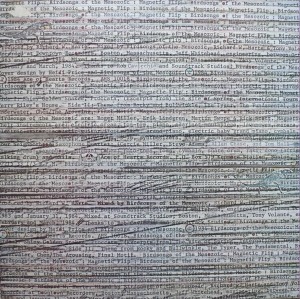
Why I Bought It: I grabbed this LP along with a handful of other post-Mission of Burma releases by Roger Miller, knowing little about it beyond Miller’s participation.
Verdict: Magnetic Flip attempts to merge Burma’s artier elements with modern classical compositions, bridging the gap between Miller’s stay in music school and his punk rock band. Using a forceful array of piano chords, organ leads, guitar textures, and drums, Birdsongs of the Mesozoic appropriate the Terry Riley/Steve Reich school of modern composition for a rock context, even naming one of the LP’s finest tracks “Terry Riley’s House.” A few of the songs touch upon Brian Eno’s instrumental work (according to Wikipedia, the band covered Eno’s “Sombre Reptiles”), giving an often claustrophobic mix room to breathe. The end result is intriguing, but often sonically overwhelming. I could have done without the reimagining of Stravinsky’s “(Excerpts from) The Rite of Spring,” which loads on too much dramatic tension for the already-laden aesthetic blueprint to stand, and the cover of the “Theme from Rocky and Bullwinkle” is curious at best. While I can appreciate the importance of forming an instrumental group in the early 1980s to push the boundaries of what independent/underground music could entail, I’d ultimately rather listen to Mission of Burma or Terry Riley than a combination of the two.
2. New Order - Confusion - Factory, 1983
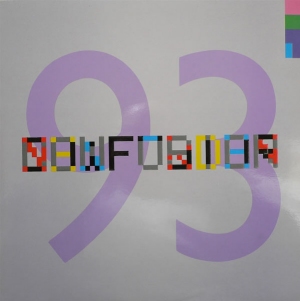
Why I Bought It: In addition to my subconscious desire to hear four version of the same New Order track, I enjoy the graphic design of Factory sleeves and Confusion is no exception.
Verdict: “Confusion” isn’t my favorite New Order song, but having an instrumental version of it allows me to avoid one of Bernard Sumner’s most vacuous lyrics, “Ask me no questions, I’ll tell you no lies.” Additionally, the emphasis on electronic dance music in “Confusion” (DJ/hip-hop producer Arthur Baker had a hand in its composition) justifies the inclusion of a beats-only version and an instrumental version, which, amazingly enough, are noticeably different. The sleeve isn’t nearly as cool as the “Blue Monday” floppy-disk homage, but matching that iconic sleeve is a tall order.
3. The Feelies - The Good Earth - Coyote, 1986
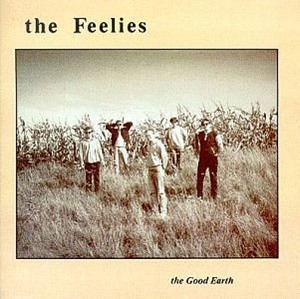
Why I Bought It: While I’ve never reached the point of obsession with the Feelies’ heralded debut Crazy Rhythms, I enjoy the record enough to try out its follow-up.
Verdict: The Good Earth starts off with a handful of relatively non-descript, jangle-heavy college-rock songs. While these songs are sonically inoffensive, they sound less like a band influencing their peers (namely R.E.M.) and more like a band being influenced by their peers, perhaps one playing catch-up after six years had passed since the release of Crazy Rhythms. Glenn Mercer’s vocals tend to settle into the music rather than peak nervously above it, the guitars rely too much on standard chord progressions, and the rhythms—even with two drummers—don’t match up with its predecessor’s namesake. Starting with the fourth track, “Slipping (Into Something),” the record shows signs of life. “Slipping (Into Something)” spreads out over six minutes, emphasizing its dueling melodic leads over the occasional jangle before accelerating into a fever pitch. “When Company Comes” returns to jangle mode, but the absence of percussion is a relaxing end to side A. Side B is consistently good, with highlights like the rhythmic pulse of “Two Rooms,” the electric leads of “Tomorrow Today,” and the quiet burn of the aptly titled “Slow Down.” Isolating these interesting elements of the Feelies’ sound helps me appreciate Crazy Rhythms more, since those elements comprise the vast majority of that album rather than the highlights of certain tracks. Still, for what seemed to be standard 1986 college rock midway through side A, The Good Earth has a great deal to offer beyond a new gateway to its superior predecessor.
4. Beck - One Foot in the Grave - K, 1994
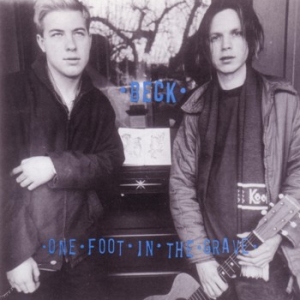
Why I Bought It: It’s significantly harder to find cheap, used vinyl pressed after 1990, so whenever I see anything resembling indie rock I’ll snap it up, particularly, like in this case, if I think it could be worth something on eBay. (While this record sells for up to $30, unfortunately there’s enough of a scratch on side A to prevent me from selling it.) I’ve never been a Beck devotee, but considering that my primary reason for this stance—my perception that Beck values style over substance in his genre-hopping exercises—doesn’t apply to a primarily acoustic endeavor, One Foot in the Grave might help me turn the corner on his work.
Verdict: Most of One Foot in the Grave sticks to a traditional folk/blues blueprint, relying heavily on Beck’s vocals, acoustic guitar, rudimentary drums, and the occasional counterpoint of K Records/Beat Happening honcho Calvin Johnson, who also produced the album. The few tracks closer to the lo-fi hodge-podge of Beck’s other early records linger on side A, which I listened to after the more stripped-down side B. There wasn’t a watershed moment of Beck appreciation, although I enjoyed “Girl Dreams,” “Hollow Log,” and “Asshole” (the lyrics of which were scribbled on the inner sleeve by the previous owner). I’ve admittedly had more fun skimming the Amazon reviews of the record, which sway from five-star odes to Beck’s “naked” album to poorly written one-star scoffs at its fidelity authored by “a kid” to this gem of a confused response, which is funny regardless of its possibly satirical intent. Where do I fit in to this glorious array of criticism? If One Foot in the Grave had been recorded in, say, 1997, after the success of Mellow Gold and Odelay, I would question its authenticity, tossing it aside as a cred-building exercise. But the timeline of its release is generous to Beck. Instead of figuring as a response to his musical surroundings or perceived audience demands, One Foot in the Grave comes off as a document of pre-stardom necessity. While the record is bolstered by Calvin Johnson, Presidents of the United States of America guitarist Chris Ballew, and Built to Spill drummer Scott Plouf, its appeal boils down to the limitations imposed by coffee houses and open mic nights. And honestly, I don’t frequent such establishments searching for the next Dylan, so I’ll take a handful of the better tracks and move along.
5. Glenn Gould - Bach: The Goldberg Variations - Columbia Masterworks, 1956
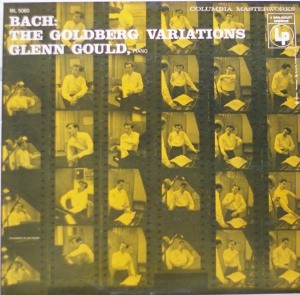
Why I Bought It: Two separate anecdotes: The first time I heard Glenn Gould’s name was when I read Giorgio Agamben’s The Coming Community in an Agamben/Kristeva seminar during graduate school. Agamben mentions Gould in a section about potentiality, essentially stating that Gould’s retreat from live performance into the studio emphasized the capacity to perform and not perform at the same time. (I could relate this concept more fully, but I’d rather avoid scouring my hard drive for a short paper on the topic.) Shortly after this instance, my mom read Gabriel Josipovici’s novel The Goldberg Variations and asked me if I could track down a copy of its musical namesake. After downloading a harpsichord rendition of the piece (the instrument the piece was written for, but I shudder at the thought of hearing a harpsichord), I grabbed Glenn Gould’s piano performance. A few months later I found the LP.
Verdict: Given that I hadn’t heard Glenn Gould’s name until a year ago, I won’t embarrass myself by critiquing his performance or J. S. Bach’s composition, although according to Wikipedia Gould himself “later came to criticize his early off-beat and lyrical interpretation, expressing reservations about its pianistic affectation, overt emotionalism, and lack of temporal unity.” I mean, I hadn’t even thought to do any of that. For my purposes, The Goldberg Variations is too busy to accompany reading, since the thirty separate variations switch up the pace frequently enough to gain my attention. Damn you, Bach and Gould, for daring to pull my attention from The Trouser Press Guide to ’90s Rock. It’s hard not to be impressed by both composer and performer, however, so I’ll continue to pick up Gould performances on the cheap—I have at least one more in the queue—but finding the right time to listen to them may be the biggest challenge.
|
|
A few years back I had a thread on this site called Record Collection Reconciliation, inspired by the number of records I’d picked up and hadn’t yet played. As most with most projects I tackle, it sputtered out before its completion. In retrospect the biggest problem wasn’t that I didn’t finish the task at hand, but that I jumped the gun on the assignment. I doubt that my collection even approached 200 LPs at the time, with roughly equivalent number of seven-inches to bolster the ranks. While I’ve more or less stopped picking up vinyl singles, my LP collection has ballooned to almost 600 in the last two years, largely thanks to gorging myself on dollar LPs. Beyond the testy concern of storage, the most pressing concern is finding the time to actually listen to this many new records, particularly for weeks when I grab more than I should.
Once I had the inclination to revive this long-dead project, I flipped through my record shelf and pulled a selection of my unheard LPs. Seventy winners were chosen, with a musical range more typical of my iPod Chicanery projects than, say, my Last.FM account, which is to say that it’s not all Colin Newman, Foals, and Wipers LPs. This selection is by no means exhaustive—as terrifying as it is to admit, I have more unheard LPs waiting in the wings—and avoids repeating artists too heavily. Sorry Elvis Costello, I will have to get to Taking Liberties and Goodbye Cruel World at a later date. Will I ever get around to a more comprehensive look at my record collection? Unlikely, but who knows how much momentum this iteration will have.
My goal is to tackle at least five LPs each week. Initially I intended to select each album at random, but given that I’ve put my most brutal version of iPod Chicanery on hold for the time being, I’ll allow myself to choose a record I probably feel like hearing at a given moment. The range of records is significant in terms of genre, quality, and familiarity (while I may not have heard a particular album from an artist, say Elvis Costello, I’m likely familiar with his other work). Expect the first entry within a few days; I’ll try to cover five records per post. I’m also considering including any records I buy between now and the end of the project, provided that it’s not a long overdue physical copy of a well-loved album.
Aside from my previous attempt at Record Collection Reconciliation, notable analogs to this project include Michael T. Fournier’s 2005 blog A–Z and two current Onion AV Club threads, Noel Murray’s Popless and the staff’s Vinyl Retentive, the latter of which currently features Engine Down’s To Bury Within the Sound LP, a record I own and have listened to. I’m sure there are others comparable sites—feel free to suggest them—but I’m by no means a voracious blog reader.
|
|
According to their MySpace page, The Narrator is playing two final shows (Chicago and New York) in May. I'll look into making it down for the New York show, but given that I'm going to three other shows that week, it might be tight. If you haven't checked out All That to the Wall or Such Triumph, you have some research to do; those are two of the finest straight-up indie rock albums of the decade. I don't want to think of how many times I played "Son of Son of the Kiss of Death" in my car within the last year. It's too bad that a vinyl pressing of All That to the Wall never came to fruition, but I'm glad that I got to see the band twice.
|
|
1. Tapes ‘n’ Tapes: I vaguely recall hearing their Pavement-aping indie rock, but their music is not something I’m familiar enough with to critique. What I hate is their name. Every time I see it in print, a voice in my head chirps “Tapes ‘n’ Tapes! Derp!” It pains me to sully this site by reprinting it, but I do it in the hopes that they either change their name or lose all media coverage.
2. ESPN: I discovered ESPN’s existence when I was nine or ten, thereby transitioning my fondness for baseball cards and box scores into live replays. I remember watching the same episode of SportsCenter several times in a row back when Craig Kilborn and Keith Olbermann were hosts. Eventually I got out of this habit, but when I was freelancing after college I’d make sure to reserve an hour of my undivided attention for Around the Horn and Pardon the Interruption. When I got digital cable, ESPNews became a constant din in the background of my activities. It is safe to say that I have watched a great deal of ESPN programming.
But what is the state of that programming? Tired, misguided, pedantic. I realized sometime last year that ESPN has devolved into a constant barrage of the same exhausting arguments, typically delivered by the worst commentators on television. I’ve seen more than enough of Skip Bayless’s ridiculous, contrarian rants , thank you very much. Aside from Outside the Lines, there was no actual reporting being done, just rehashes of worn arguments, saccharine-laced human interest stories, or, worst of all, ESPN fluff pieces. Should I mention their live sports programming? Without hockey to draw me in or NHL2Night to cover the sport, it’s of limited interest to me. They have the worst baseball coverage team (Joe Morgan, ahem), Dick Vitale blaring over college basketball games, and far too much poker. Aside from the occasional college basketball or college football game, there isn’t much reason for me to watch the channel anymore. So I decided to make my New Year’s resolution to boycott the network.
Amazingly enough the boycott has stuck. The only time I’ve considered cheating was when the Patriots lost the Super Bowl—perhaps the greatest blow to another hated institution, Boston sports talk radio—and when I skipped to the channel Emmitt Smith was about to open his mouth. The impulse was gone. My stamina has been helped by the fact that my two colleges of interest—University of Illinois and Boston College—were downright wretched at basketball this year. I’d like to think that they’ll improve enough next year to get me to break this resolution, but I can hardly express the same level of optimism about ESPN.
3. 2008 March Madness: Avoiding ESPN for the last three months prevented me from gaining much of a foothold on the happenings of college basketball, so after Illinois made its failed run in the Big Ten tournament, I struggled to interest myself with the prospect of the annual basketball feast. Opting for episodes of Dexter over a large number of the first-round games didn’t help, but neither did the field itself. The coverage I read seemed to applaud having four number one seeds reach the final four as a long overdue justification of tournament’s conclusion, but that is damned chalk. If Davidson had put up a winning basket, they would have been my horse, but instead I’m left with one school that beat my college in its only title game appearance (UNC, who I’ve long hated anyway), a school who poached my school’s coach (Kansas), the school with the most titles (UCLA), and a school whose coach is desperately trying to portray his team as “friends first and teammates second,” gag (Memphis). As it turned out, I will adopt Memphis as a one-game favorite, praying that Bill Self doesn’t get to justify his departure. At the very least, it’ll be entertaining basketball, but I can’t say that my excitement level has flown off the charts. Hell, I forgot the semi-finals were even on today.
4. Murder by Death: When I first heard Little Joe Gould at the Highdive in Champaign, their bass player, Matt Armstrong, was warming up with the bass line to Mogwai’s “Tracy.” That anecdote has stuck for me for two reasons: first, I remember talking to Matt about it afterward and finding out that we had similar musical taste, and second, they actually sounded like Mogwai during parts of that set. I can’t think of the band without thinking of how much has changed. The original keyboard player and drummer are gone. The warm Cure influence from the first record has vanished. Their fixation on the old West is all-consuming. The post-rock elements have disappeared. The spectacle of their live show is gone. The lyrical narratives of Johnny Cash and Tom Waits have become the biggest touchstones for their last two albums, but the scope of the music has been pared down to pop structures. They’ve certainly found their niche, touring with the Reverend Horton Heat on a few occasions, but I’ve accepted that I am not a part of that niche audience. I still enjoy their first few records, though. Like the Exorcist, but More Breakdancing isn’t a cohesive document, but that’s part of the appeal. They wrote Cure-informed pop songs, post-rock epics, and aggressive rock songs, giving their live sets surprising variety. Who Will Survive and What Will Be Left of Them? has gained thematic and structural cohesion, but lost some of its predecessor’s spirit in the process. I miss the band that made those records.
5. Mono: I recently replaced the cassette adaptor for my iPod/CD player, so I didn’t anticipate it going on the fritz this quickly. But almost every time I get in the car, I only hear music out of the right channel. If I tinker with the cord I can get it to work again, but only hearing music from the opposite side of the car is threatening to drive me insane.
|
|
Here’s the completion of my ten. Next post will be bottom five.
6. The Wire : I finally caved to the whims of numerous friends and media outlets who insisted that this show was the greatest thing in the history of mankind. Having watched the first season, I understand where they’re coming from. It does so many things that I wish 24 would do: fleshes out supporting characters, avoids contrived plot twists, develops fruitful side plots, casts aside any notion of caricature, and most of all, maintains some sense of realism. I also understand the trade-off—The Wire is not as pulse-pounding as 24, except for a few occasions—but as the last few seasons of 24 have demonstrated, pursuing the big thrill gets in the way of the long-term payoff. I’ve started season two, but since I’m only through one episode right now I can’t comment on the further trajectory.
7. Foals – Antidotes: The advance of Antidotes, Foals’ debut album on Sub Pop, sat in a poorly marked folder on my hard drive for what seemed like ages. I remember digging the first track, “The French Open,” but getting annoyed by “Cassius” and not giving the rest of the record a chance. My annoyance threshold for modern dance-punk is decidedly small, particularly in the vocals department, but giving Antidotes a full listen made me appreciate its place in the recent surge in the genre. My issue with Bloc Party—my initial reference point for Foals—was how they tangled up their Gang of Four fetish with a vague approximation of that band’s political platform, which came across as a modern-day version of U2’s “Let’s change the world” mindset. Foals is thankfully smart enough to avoid U2 as a reference point, reminding heavily of pre-Mirrored Battles in their arrangements and early Q & Not U (and Bloc Party at times) in the delivery. Having David Sitek of TV on the Radio produce the album was a smart move, giving depth to an already elaborate framework. While the Battles-aping “Two Steps, Twice” surges once the chorus hits, the comparative ease of “Olympic Airways” does the best job of putting my occasional unease about the genre to rest.
8. Michael Azerrard – Our Band Could Be Your Life: According to the inscription on the inside cover, I got my copy of this book for Christmas in 2001 and probably read it over that winter break. My initial read caused me to fill in some of the major gaps in my collection; I remember tracking down Mission of Burma, Dinosaur Jr., and older Sonic Youth while making a mental note to eventually hit the other bands I’d missed. That mental note has come to fruition in the last few years, with the Minutemen, the Replacements, and Minor Threat coming into my collection. Hell, I even picked up a used copy of the first Butthole Surfers EP a few weeks back, even though I’d vowed to ignore their existence after the Touch & Go affair. Re-reading the chapters on those bands has been quite rewarding, if somewhat less informative now that I’ve been focusing on 1980s American post-punk.
9. They Live: Comcast’s OnDemand listings are usually the dregs of cable movies, but after reading an entry into The Onion’s AV Club’s New Cult Canon series, I was thrilled to get another chance to see it. I admittedly drifted for the first thirty minutes of the film, but once the plot is exposed, They Live holds up as a far more scathing companion to Repo Man’s social criticism. Elsewhere in the New Cult Canon, Clerks gets scoffed at, perhaps rightly so, but I’m far more interested in seeing what they think of Primer, one of my favorite films from this decade. Perhaps they’ll even say what Shane Carruth is up.
10. The Photographic - Pictures of a Changing World: Every now and then I enjoy chiming guitars and gradual swells in instrumental rock form. Now is one of those times. The Photographic isn’t breaking any ground here—Explosions in the Sky is the biggest touchstone—but they pull it off and that’s enough for a few listens.
|
|
I let my Wire obsession get the better of me last Friday. In addition to buying the double LP of their rarities compilation Turns and Strokes (which has excellent Wire versions of the later Colin Newman tracks “Safe,” “Lorries,” and a few others) and the Kidney Bongos LP, I found something that was filed next to a copy of Colin Newman’s Not To LP called C. Newman and Janet Smith. I’d never heard of it before, but the timeframe seemed right; Colin Newman was in Germany in the mid-1980s recording with his future wife’s band. C. Newman is credited with vocals and arrangement, which seems about right. So instead of thinking critically about the situation—“Sebastian, you have a limited record buying budget right now. Why take a chance on this when you could buy a Roxy Music LP and an XTC LP for the same price? Those are known quantities.”—I plopped it down with my other Wire-related pick-ups and an LP of Charles Mingus’s Mingus Ah Um. On the drive back from RRRecords in Lowell I started getting the sinking suspicion that this C. Newman was not in fact Colin, and when I got home I let a Google search inform me of my mistake.
Initially I wasn’t going to listen to the record out of spite, but when I saw this listing describe it as art-rock/jazz, I figured I’d give it a shot. Additionally, Janet Smith turned out to be Robert Smith’s sister. (Requisite Achewood quote: “It is silly to like The Cure!”) Halfway through the first song, I’ve learned that Chris Newman has an obnoxious baritone and worse lyrics, although those may very well be taking the piss. I wanted to listen to the whole thing, but could only make it through two-and-a-half songs. I may suffer through iPod Chicanery (some of the time), but this record was torture, especially since I paid full price for it. If you are a Cure super-completist, check eBay in the next few weeks.
With regard to my history of record-buying mistakes, I remember being completely ashamed when I purchased a second copy of Idlewild’s Hope Is Important from Reckless in Chicago under the false impression that I didn’t own it. For me, record buying mistakes are an issue of memory, not taste. Finding out that a new record doesn’t meet my expectations has largely disappeared in the age of file-sharing, but even before that era I viewed that experience as a learning process. My biggest concern is my capacity to bring whatever knowledge I have from reading reviews, listening to records, getting recommendations, etc. into the record store. As my record collection has ballooned to almost 1700 items, my ability to remember which Elvis Costello LPs I already own has diminished. Given that I’ve been reading a biography of Wire, I probably should have thought a bit more critically about the suspect origins of this LP. If nothing else, I should be proud of the fact that I can only think of a couple of similar errors in my history of record buying.
|
|
My current writer’s block is a bit confounding, since I don’t think there’s a particular reason why I should open up Microsoft Word, type a few lines, and then shrug my shoulders and close the application, but it certainly happens often enough. Instead of trying to come up with some tremendous conceit to get my blood flowing again, I’ll just expand my usual sidebar feature by writing about ten things I’ve enjoyed recently and hopefully working out some of my nagging concerns in the process. Here are the first five items—as you can see expanding those entries takes up a good amount of time.
1. Colin Newman’s “& Jury”: While my Last.fm account tracks a larger period of time, I typically pay more attention to the play count in iTunes nowadays, having switched over to the software back in September in order to expedite transfers to my iPod. Currently the most played track is “& Jury” from Colin Newman’s 1980 solo debut A–Z with a whopping 40 plays since February 10, 2008. Given my obsession with early Wire, I’m rather astonished that it took me this long to delve into Newman’s solo discography, but such reticence wasn’t entirely undeserved. As the review on Wireviews mentions, A–Z is decidedly hit or miss, with the misses being rather annoying, although I can appreciate the anti-single appeal of “B.” But “& Jury” is easily on par with my favorite late Wire tracks, particularly since its urgent chorus (“We are the judges too”) peels back some of Wire’s trademark detachment. “But for a moment I felt a need to be closer to the reasons / And what I saw I can’t describe, I understand / That we are the judges too” furthers that reading, but what’s exposed isn’t necessarily genuine emotion but the recognition that pure detachment has its faults and its limitations.
I’ve tracked down most of Newman’s pre-1990 catalog and here’s the lowdown: A–Z is scattered, but frequently great; Provisionally Entitled the Singing Fish is an occasionally compelling entry into short Eno-esque instrumentals (think Another Green World); Not To has the closest connection to Wire’s 154, in part because some of its songs were originally meant for Wire’s fourth LP, but it’s also more consistent than A–Z, if slightly less sonically compelling; Commercial Suicide issues more synths, less percussion, and a more measured approach to songwriting, but its languid pace makes it difficult for me to make it through the entire album; CN1 is an odds-and-ends EP with a great vocal version of “Fish One” from Provisionally Entitled… called “No Doubt” (with vocal hooked based around the lyric “We all got awfully good at dying”); and It Seems completes Newman’s voyage into sequenced new wave with its great synth-heavy opener “Quite Unrehearsed,” but sounds far more dated than any of Newman’s other efforts.
2. Dexter: At the urging of my friend Jackie, I started watching the Showtime/CBS series Dexter last week. It didn’t take me more than five days to make it through the twenty-four available episodes, which is about par for my other speedy television catch-ups (Lost, Friday Night Lights, The Office). The first season was nearly flawless, as the writers balanced Dexter’s serial killer exploits, personal life (sister, girlfriend), professional duties as a blood splatter analyst for Miami PD forensics, and growing recognition of his past with aplomb. The second season had a less grounded plotline, reminding me of some of the lesser moments of recent Friday Night Lights and 24 seasons, but thankfully the resolution didn’t threaten the show’s future appeal. Michael C. Hall’s performance in the title role carries the series, but Julie Benz and Jennifer Carpenter’s respective portrayals of Dexter’s girlfriend and sister give the show depth. Some of the other characters seem more stock than they should, but there is a fairly large ensemble to introduce so perhaps that’s understandable. My biggest question is how much CBS has to edit out of the series in order to re-air the episodes—there is a great deal of blood and a good amount of nudity in the series—and whether fans of CBS’s flagship CSI franchises will appreciate Dexter’s connection to the forensics field despite its deeper bloodlines. In an ironic twist, I missed some of the opening rounds of the NCAA tournament watching the only reasonably good show on CBS on my computer. The third season starts September 30th, giving me something to look forward to a day after my birthday.
3. Wipers - Youth of America: The biggest problem with my current iteration of iPod Chicanery is that I included too many records that simply haven’t connected with me. The Pop Group, Suicide, Pere Ubu, This Heat, and other forays into post-punk haven’t provided the same level of interest as my previous favorites from the era. From the other end of the spectrum, my attempt at finally appreciating Black Flag hasn’t come to fruition, either. While I’m hesitant to say that I enjoy a limited spectrum of post-punk and punk/hardcore, since my tastes may very well evolve to appreciate more of the post- aspects of the genre, hearing the guitar-centric songs of the Wipers was exhilarating. Part of the excitement came from finally understanding where Zoom’s antsy guitar sound came from—I’d seen the Wipers used as a point of comparison in every Zoom review I’d come across, but never bothered to track down the originators until last week. Yet Youth of America has far more value than its guitar sound, since “No Fair,” “When It’s Over,” and the title track provide an epic counterpart to the other three songs’ comparatively lesser scope and place the Wipers (in my mind, at least) firmly in the post-punk canon. Youth of America has a nearly apocalyptic feel in those longer tracks, in part due to Greg Sage’s fondness for spoken-word narratives. I’ve listened to Is This Real? and Over the Edge as well and enjoy both of them, but Youth of America seems closer to the artistic statement records I relish so much (see: first three Wire albums). It’s great that Jackpot has reissued Youth of America and Is This Real? on LP, so hopefully Over the Edge is also forthcoming.
4. M83 – “Kim & Jessie and “Couleurs”: I’ve hesitated from slagging on pre-release albums in the idea that I’m far more concerned with helping people buy records than dissuading them from doing so, but M83’s upcoming Saturdays = Youth is enough of high-profile release that I don’t think my darts will puncture it too badly. I’ll start with the two tracks mentioned, since they’d make an excellent double a-side single if M83 had the stones for it. “Kim & Jessie” is kin to the last record’s twin singles, “Teen Angst” and “Don’t Save Us from the Flames,” but relates even more to 1980s synth-pop, particularly Tears for Fears’ “Head Over Heels.” It’s no slight to say that “Kim & Jessie” could slip into Donnie Darko’s soundtrack if Richard Kelly’s nostalgia was less of a deciding factor. I’ve already read at least one site mention that “Couleurs” sounds more like a remix of an M83 song than the song itself, but I appreciate the sentiment. If I had to name the remixer, I’d guess Port-Royal, since “Couleurs” sounds enough like Afraid to Dance with less emphasis on crescendos and elongated fade-outs. “Needs more digital cowbell” would be a fine heckle if anyone sees them on their upcoming tour and bonus points if you can do it in French.
Now for the rest of the record. Whereas Dead Cities, etc. worked as an album because the non-singles blended into a greater aesthetic (My Bloody Valentine shoegaze as performed by analog synths), Before the Dawn Heals Us’s increased emphasis on vocals authored several wretched mistakes that crippled the album’s flow. Now Saturdays = Youth attempts to complete the move into a electro-indie band with a new female vocalist and a greater emphasis on rousing anthems like “Teen Angst.” Second single “Graveyard Girl” seems like it’s pandering with a spoken word discussion of what it’s like to be fifteen. “Up!” has the single funniest opening couplet in recent memory, as the female vocalist intones with utmost sincerity that “If I clean my rocket / We’ll go flying today.” The rest of the record tries with varying success to incorporate these female vocals into their synth-pop framework. If I gave the record more time, I’d probably enjoy “We Own the Sky” and “Dark Moves of Love,” but I don’t think I can put that much effort into another ill-fated attempt to revive new wave.
5. Kevin S. Eden - Wire: Everybody Loves a History: I’d argue that I enjoy a history more than most, since I tracked down this rather out-of-print biography of Wire that tracks their careers until 1990’s Manscape. The most surprising aspect of the book is how much of it (55 of 188 pages) covers Graham Lewis and Bruce Gilbert’s various exploits during Wire’s hiatus between 154 and Snakedrill. It shouldn’t be a surprise that I prefer Colin Newman’s more song-based output during that era, so I was a bit disappointed that nearly a third of my bathroom reading for the next while would be about Dome and modern art installations. It’s interesting to read about the divisions between the Lewis/Gilbert and Newman/Thorne camps that developed during 154, since that record is so clearly a product of internal tensions. Yet I would have preferred more emphasis on the first three records, since they’re Wire’s classics. Perhaps it’s merely the weight of the timeline that is the source of this frustration, since those records were produced in a three-year span and the book covers the decade that follows them. Everybody Loves a History, like many of the 33 1/3 books that have been released recently, is flawed, but worth checking out. If nothing else, it could be a great source of inspiration for a 33 1/3 entry for Chairs Missing or 154.
|
|
Opening Bell: After starting things off quietly with the title track from Brian Eno and Harold Budd’s Ambient II: The Plateaux of Mirror, I got the croaking bass of Smog’s “Natural Decline” from Rain on Lens. While I like a reasonably rocking Bill Callahan song as much as the next guy, it wasn’t until that track ended and Nas’s “Memory Lane (Sittin’ in Da Park)” came on that I felt like this project had really started. I’d put off listening to Illmatic despite its lofty status in “best rap albums” discussions, but “Memory Lane” quickly informed me of what I’d been missing.
Ghostface vs. Wu Tang: I’d skimmed The Big Doe Rehab and 8 Diagrams, but I hadn’t given either record a dedicated listen. Hearing Wu Tang’s “Take It Back” and Ghostface’s “Supa GFK” back to back followed quickly by Ghostface’s “Slow Down” made it clear that these records would be in dialogue throughout this project. The main thing I’ve noticed so far is how Ghostface’s incorporation of R&B vocals on “Slow Down” works better than Wu Tang’s attempts on “Stick Me for My Riches,” even though I enjoy the verses of that Wu Tang song enough to overlook my concerns. Still, I may end up leaning toward 8 Diagrams in the production department since I wasn’t expecting the woozy RZA solo track “Sunlight,” but it held up well enough on its own.
Strange Remembrace: Though I’d recently picked up T. Rex’s The Slider on vinyl, I hadn’t listened to the second side yet and was pleased that “Buick Mackane” rivaled the songs I’d already heard. But what struck me about hearing a song from The Slider was remembering that my English 101 instructor (and erstwhile Rectangle guitarist) Matt Mitchell assigned a poem on this record in my freshman intro to poetry course. I imagine that I have the course packet floating around somewhere, but I’m a bit frustrated that Googling hasn’t come up with anything yet. I remember enjoying that poem but thinking “Yeah, I doubt I’ll ever get a record from the ‘Bang a Gong (Get It On)’ band.” Oops.
Post-rock You Say: Despite Simon Reynolds coining “post-rock” in its honor, I’d never given Bark Psychosis a solid listen. Three songs from Hex have come up so far (within seven tracks, no less), with “The Loom” being the most memorable of them. I was at the laundromat at the time and had to compete with some blaring piano from a Spanish-language soap opera, but the subtlety of the track still came through. “Pendulum Man” was a bit too ambient for that environment, but it made sense in connection to the more fleshed-out “The Loom” and “Absent Friend.” At the very least I have another reference point (along with Talk Talk) for the Ghost Wars recordings that have come out so far.
If I Had Any Doubt…: …about The National’s Alligator living up to my fondness for Boxer, “City Middle” erased it.
Best Song of the Round: The Saints’ “Know Your Product” is clearly a precursor for Rocket for the Crypt, but it’s hard to think of any RFTC songs that were as melodic in the horn accompaniment.
|
|
Electronic post-rockers Errors have finally announced the details of their forthcoming full-length, It Is Not Something, But It Is Like Whatever. Ten tracks, including "Salut! France," come out later this spring on Rock Action. They've uploaded an album preview of sorts to their MySpace account, which consists of a high-hat only version of one of the songs. I can only imagine that this is a first.
Amazing comment from Mogwai guitarist and Rock Action impresario Stuart Braithwaite: "I think we might need to have wee chat about that album title boys."
|
|
